FDA Requests Further Information
Memory Pharma provides update on Phase 2a trial of MEM 3454 in alzheimer's disease; FDA requires further explanations of revisions Co announces an update on the investigational new drug application filed in Sept 2006 with the FDA for MEM 3454.
The FDA has advised the co that in order to fully review the toxicology reports that were submitted with the I.N.D, the agency requires further explanations of revisions that were made to those reports since they were submitted with the co's first I.N.D for this trial in May, and as a result the proposed Phase 2a clinical trial for MEM 3454 in Alzheimer's disease has been placed on clinical hold. The FDA has also deferred assessment of the adequacy of the Investigator's Brochure for the trial pending submission of the additional information.
MEMY also reported that the FDA confirmed that the clinical hold was not related to any manufacturing issues with MEM 3454 and that the potential impurities issue, previously raised by the FDA in connection with the co's first IND for the proposed Phase 2a clinical trial of MEM 3454, had been adequately resolved. The co believes that no additional studies or data will be required to address the FDA's questions and that, as a result, it should be able to provide to the FDA, by early November, the information necessary to facilitate the FDA's review
The nicotinic alpha-7 receptor target represents a novel approach to thetreatment of CNS disorders, and we are pleased by the rapid progress of MEM3454," said Peter Hug, Roche's Global Head of Pharma Partnering. "Ourrelationship with Memory Pharmaceuticals has been a productive one and allowsus to leverage their strengths in CNS drug discovery and development.
Tuesday, October 17, 2006

Quick Market Update:

U.S. stocks trimmed losses Tuesday after a better-than-expected report on the housing sector eased concerns about a slowdown in the nation's economy, with Johnson & Johnson a notable outperformer following strong quarterly results.
The Dow industrials fell 40 points to 11,940, off a session low of 11,887.
Cytomedix Stock tumbles on FDA Ruling
Shares of Cytomedix Inc. lost more than half of their value on Tuesday after it said U.S. regulators denied the company's claim on a gel for healing diabetic foot ulcers.
A unit of the Food and Drug Administration denied the claim that Cytomedix's AutoloGel is substantially equivalent to a legally marketed device, the company said in a statement. [also there is a chance for host rejection, as bovine thrombin is antigenic.]
The primary grounds for the rejection appeared to be the use of bovine thrombin, a clotting agent derived from cows, in the gel, the company said.
Bovine thrombin is used on humans in surgery and other instances to stop bleeding, but the FDA body cited studies that said it could also lead to a bleeding tendency, the company added.
Cytomedix said it will appeal the agency's decision and expects the process to be completed in 60 to 90 days.
The company's shares were down $1.46 at $1.29 in morning trade on the American Stock Exchange
A unit of the Food and Drug Administration denied the claim that Cytomedix's AutoloGel is substantially equivalent to a legally marketed device, the company said in a statement. [also there is a chance for host rejection, as bovine thrombin is antigenic.]
The primary grounds for the rejection appeared to be the use of bovine thrombin, a clotting agent derived from cows, in the gel, the company said.
Bovine thrombin is used on humans in surgery and other instances to stop bleeding, but the FDA body cited studies that said it could also lead to a bleeding tendency, the company added.
Cytomedix said it will appeal the agency's decision and expects the process to be completed in 60 to 90 days.
The company's shares were down $1.46 at $1.29 in morning trade on the American Stock Exchange
Another Hepatitis Protease Inhibitor: Vertex drug could trump everyone else
Vertex pipeline drug for hepatitis could top $5 billion: analyst
-- Vertex Pharmaceuticals, a small biotech, and its marketing partner Johnson & Johnson stand to gain billions of dollars in annual sales if their experimental hepatitis drug is successful, analysts say.
Vertex (down $1.06 to $35.71, Charts), a biotech based in Cambridge, Mass., is experimenting with a potential blockbuster hepatitis C treatment called VX-950. If tests are successful, the drug could enter the American market by 2009, reaching peak U.S. annual sales of $3 billion by 2013, said Ding Ding, analyst for Maxim Group. Most of the U.S. sales would go to Vertex.
In addition, overseas annual sales would peak at $2.4 billion by 2015, said Ding. Most of the non-U.S. sales would go to Johnson & Johnson (up $1.16 to $66.09, Charts), which would market the drug overseas.
Hepatitis C is a blood-borne viral infection that damages the liver and can result in chronic infection and disease, according to the National Institutes of Health. It has infected three million Americans and 170 million people worldwide.
"This is probably the most efficacious anti-Hepatitis C oral compound that will come to market," said Ding. "VX-950 is the one with the most promise so far."
Geoff Porges, analyst for Sanford C. Bernstein, also projects blockbuster sales for VX-950, peaking at about $2.7 billion in annual revenue by 2011. That includes $1.8 billion in U.S. sales, with most of that going to Vertex, and $840 million in non-U.S., with the lion's share going to Johnson & Johnson.
Les Funtleyder, analyst for Miller Tabak, said that VX-950 and other hepatitis drugs could be well-received in the emerging markets of Asia, where hepatitis is a more pervasive health problem. In the coming years, individuals in Asia will have more personal income to spend on healthcare, and drugs like VX-950 could get a sales boost, said Funtleyder.
As in previous HCV drugs, its a viral protease inhibitor that stops viral replication. HUGE drug targets.
-- Vertex Pharmaceuticals, a small biotech, and its marketing partner Johnson & Johnson stand to gain billions of dollars in annual sales if their experimental hepatitis drug is successful, analysts say.
Vertex (down $1.06 to $35.71, Charts), a biotech based in Cambridge, Mass., is experimenting with a potential blockbuster hepatitis C treatment called VX-950. If tests are successful, the drug could enter the American market by 2009, reaching peak U.S. annual sales of $3 billion by 2013, said Ding Ding, analyst for Maxim Group. Most of the U.S. sales would go to Vertex.
In addition, overseas annual sales would peak at $2.4 billion by 2015, said Ding. Most of the non-U.S. sales would go to Johnson & Johnson (up $1.16 to $66.09, Charts), which would market the drug overseas.
Hepatitis C is a blood-borne viral infection that damages the liver and can result in chronic infection and disease, according to the National Institutes of Health. It has infected three million Americans and 170 million people worldwide.
"This is probably the most efficacious anti-Hepatitis C oral compound that will come to market," said Ding. "VX-950 is the one with the most promise so far."
Geoff Porges, analyst for Sanford C. Bernstein, also projects blockbuster sales for VX-950, peaking at about $2.7 billion in annual revenue by 2011. That includes $1.8 billion in U.S. sales, with most of that going to Vertex, and $840 million in non-U.S., with the lion's share going to Johnson & Johnson.
Les Funtleyder, analyst for Miller Tabak, said that VX-950 and other hepatitis drugs could be well-received in the emerging markets of Asia, where hepatitis is a more pervasive health problem. In the coming years, individuals in Asia will have more personal income to spend on healthcare, and drugs like VX-950 could get a sales boost, said Funtleyder.
As in previous HCV drugs, its a viral protease inhibitor that stops viral replication. HUGE drug targets.
Monday, October 16, 2006
Expected Active Trading Tuesday
Companies whose shares are expected to see active trade in Tuesday's earnings reports are Intel Corp., Johnson & Johnson and CA Inc.
Intel is expected to report third-quarter earnings of 18 cents a share, according to analysts polled by Thomson First Call.
International Business Machines Corp. is expected to post earnings of $1.35 a share for the third quarter.
Johnson & Johnson is expected to report third-quarter earnings of 93 cents a share for the third quarter.
Merrill Lynch & Co. is expected to post earnings of $1.47 a share for the third quarter.
Motorola Inc. is expected to report third-quarter earnings of 34 cents a share.
Novellus Systems Inc. is expected to post earnings of 51 cents a share for the third quarter.
Office Depot is expected to report third-quarter earnings of 44 cents a share.
U.S. Bancorp is expected to post earnings of 66 cents a share for the third quarter.
United Technologies Corp.is expected to report third-quarter earnings of 96 cents a share.
Yahoo is expected to post earnings of 11 cents a share for the third quarter.
E.R. from major Biotech will be posted.
Intel is expected to report third-quarter earnings of 18 cents a share, according to analysts polled by Thomson First Call.
International Business Machines Corp. is expected to post earnings of $1.35 a share for the third quarter.
Johnson & Johnson is expected to report third-quarter earnings of 93 cents a share for the third quarter.
Merrill Lynch & Co. is expected to post earnings of $1.47 a share for the third quarter.
Motorola Inc. is expected to report third-quarter earnings of 34 cents a share.
Novellus Systems Inc. is expected to post earnings of 51 cents a share for the third quarter.
Office Depot is expected to report third-quarter earnings of 44 cents a share.
U.S. Bancorp is expected to post earnings of 66 cents a share for the third quarter.
United Technologies Corp.is expected to report third-quarter earnings of 96 cents a share.
Yahoo is expected to post earnings of 11 cents a share for the third quarter.
E.R. from major Biotech will be posted.
Roche, InterMune Combine to develop hepatitis C treatments
Oct 16. Roche (ROG.VX: Quote, Profile, Research) and InterMune Inc. (ITMN.O: Quote, Profile, Research) said on Monday they have agreed to develop and commercialize products from InterMune's hepatitis C protease inhibitor program.
The agreement includes InterMune's ITMN-191, which is expected to enter clinical trials before year end. The companies will also collaborate on a research program to identify, develop and commercialize novel second-generation protease inhibitors for treatment of hepatitis C.
Upon closing, Roche will pay InterMune an upfront payment of $60 million. Assuming the successful development and commercialization of ITMN-191 in the U.S. and other countries, InterMune could potentially receive up to $470 million in milestones, including $35 million within the next 12 months, the companies said.
WHAT IS THIS DRUG AND WHAT DOES IT TARGET?Current treatment options for chronic HCV infections provide sustained virologic response rates of ~50%, indicating novel therapeutic approaches are needed. We therefore embarked on a rational drug design campaign to produce inhibitors of the HCV NS3/4A protease. ITMN 191 emerged from this discovery effort and was nominated as a preclinical candidate.
The HCV genome encodes for glycoproteins E1 and E2 that form the structural proteins
of the virion. Non-structural (NS) proteins NS2, NS3,NS4A, NS4B, NS5A and NS5B have important roles in the polyprotein processing and HCV replication (they are termed polymerases). These are the drug targets.
The agreement includes InterMune's ITMN-191, which is expected to enter clinical trials before year end. The companies will also collaborate on a research program to identify, develop and commercialize novel second-generation protease inhibitors for treatment of hepatitis C.
Upon closing, Roche will pay InterMune an upfront payment of $60 million. Assuming the successful development and commercialization of ITMN-191 in the U.S. and other countries, InterMune could potentially receive up to $470 million in milestones, including $35 million within the next 12 months, the companies said.
WHAT IS THIS DRUG AND WHAT DOES IT TARGET?Current treatment options for chronic HCV infections provide sustained virologic response rates of ~50%, indicating novel therapeutic approaches are needed. We therefore embarked on a rational drug design campaign to produce inhibitors of the HCV NS3/4A protease. ITMN 191 emerged from this discovery effort and was nominated as a preclinical candidate.
The HCV genome encodes for glycoproteins E1 and E2 that form the structural proteins
of the virion. Non-structural (NS) proteins NS2, NS3,NS4A, NS4B, NS5A and NS5B have important roles in the polyprotein processing and HCV replication (they are termed polymerases). These are the drug targets.
Vical to Sell 2.5 Million Shares in Direct Offering, Raise $12.5 Million
Biopharmaceutical company Vical Inc. said Monday it plans to sell $12.5 million in stock as part of a direct offering to raise financing for existing drug programs and general corporate purposes.
Vical said it received firm commitments from undisclosed investors to buy 2.5 million shares at $5.02 each.
That is a discount of 1.6 percent from the stock's closing price of $5.10 on Friday, but equal to the closing bid price on the Nasdaq, according to Vical.
The company expects the sale to close Monday.
Vical is focused on DNA vaccines through new age delivery mechanisms.
The stock is trading up 9 cents just before closing.
Vical said it received firm commitments from undisclosed investors to buy 2.5 million shares at $5.02 each.
That is a discount of 1.6 percent from the stock's closing price of $5.10 on Friday, but equal to the closing bid price on the Nasdaq, according to Vical.
The company expects the sale to close Monday.
Vical is focused on DNA vaccines through new age delivery mechanisms.
The stock is trading up 9 cents just before closing.
DOW closing in on 12,000
U.S. stocks rose Monday, buoyed by technology-sector strength, but the Dow Jones Industrial Average saw choppy trade as a broker upgrade for Alcoa Inc. was tempered by downgrades for General Electric Co. and Home Depot Inc.
The Dow Jones Industrial Average rose 6 points to 11,966.
A lot of people missed out on the recent rally, which is leading to a sort of emotional stampede which has nothing to do with fundamentals," according to Michael Metz, chief investment strategist at Oppenheimer & Co.
Metz said the Dow Industrials are set to break through the 12,000 mark, barring any major bad news.
On the broader market for equities, advancers outpaced decliners by 19 to 10 on the New York Stock Exchange and by 8 to 5 on the Nasdaq.
The Dow Jones Industrial Average rose 6 points to 11,966.
A lot of people missed out on the recent rally, which is leading to a sort of emotional stampede which has nothing to do with fundamentals," according to Michael Metz, chief investment strategist at Oppenheimer & Co.
Metz said the Dow Industrials are set to break through the 12,000 mark, barring any major bad news.
On the broader market for equities, advancers outpaced decliners by 19 to 10 on the New York Stock Exchange and by 8 to 5 on the Nasdaq.
OMRIX Biopharmaceuticals Announces Positive Phase 3 Clinical Trial Results for Human Thrombin--Shares Drop
OMRIX Biopharmaceuticals, Inc. a commercial-stage biopharmaceutical company that develops and markets biosurgical and antibody-based products, announced today positive results from its Phase 3 pivotal clinical trial of human thrombin in achieving hemostasis in general surgery procedures. The non-inferiority clinical trial evaluated the equivalence of topical human thrombin to bovine thrombin in terms of safety and efficacy. All primary endpoints were met.
"We are pleased with the results of our pivotal Phase 3 Thrombin trial and intend to file our BLA by November 15, 2006," said Robert Taub, President and Chief Executive Officer. "OMRIX is committed to advancing its biosurgery pipeline and commercializing a product portfolio of safe, effective and easy to use solutions for surgeons worldwide."
THROMBIN is an enzyme in the blood coagulation cascade. Blood coagulates by the transformation of soluble fibrinogen into insoluble fibrin. There are steps in the cascade to arrest bleeding from a damaged blood vessel and thrombin one of these enzymes. Many of these clotting factors are targets for drug therapy. This drug will replace bovine thrombin, since there have been problems with immune reactions (rejection).
The stock is down 14% to 17.51 at this hour. The stock is down even though all endpoints of the trial were met, yet the net effect of the drug was not as effective as planned.(NASDAQ:OMRI)
"We are pleased with the results of our pivotal Phase 3 Thrombin trial and intend to file our BLA by November 15, 2006," said Robert Taub, President and Chief Executive Officer. "OMRIX is committed to advancing its biosurgery pipeline and commercializing a product portfolio of safe, effective and easy to use solutions for surgeons worldwide."
THROMBIN is an enzyme in the blood coagulation cascade. Blood coagulates by the transformation of soluble fibrinogen into insoluble fibrin. There are steps in the cascade to arrest bleeding from a damaged blood vessel and thrombin one of these enzymes. Many of these clotting factors are targets for drug therapy. This drug will replace bovine thrombin, since there have been problems with immune reactions (rejection).
The stock is down 14% to 17.51 at this hour. The stock is down even though all endpoints of the trial were met, yet the net effect of the drug was not as effective as planned.(NASDAQ:OMRI)
Sunday, October 15, 2006
Pfizer Gets Into Vaccines
Pfizer Inc. made a strategic advance into vaccines, acquiring DNA vaccines specialist PowderMed Ltd. The value of the deal, which includes a needle-free delivery system and a portfolio of products, was not disclosed.
PowderMed's lead product against seasonal flu has just entered a Phase I/IIa challenge trial in London and a U.S. Phase I trial, and is in line to become the first DNA vaccine to reach the market.
PowderMed's particle-mediated epidermal delivery technology uses pressurized helium to deliver microscopic gold particles coated in DNA directly to antigen-presenting cells in the epidermis. Once inside the APCs, the DNA become transcriptionally active, producing the encoded proteins, which then are presented by the APCs to lymphocytes, initiating a T-cell mediated immune response.
Apart from the immunological advantages of that route of delivery, the gold particle formulations are stable at room temperature, making them easy to store, and the needle-free device opens up the possibility of self-administration. The delivery device can be used to deliver conventional vaccines and other drugs in a powdered format, also.
PFE closed at 27.59 friday on NYSE.
PowderMed's lead product against seasonal flu has just entered a Phase I/IIa challenge trial in London and a U.S. Phase I trial, and is in line to become the first DNA vaccine to reach the market.
PowderMed's particle-mediated epidermal delivery technology uses pressurized helium to deliver microscopic gold particles coated in DNA directly to antigen-presenting cells in the epidermis. Once inside the APCs, the DNA become transcriptionally active, producing the encoded proteins, which then are presented by the APCs to lymphocytes, initiating a T-cell mediated immune response.
Apart from the immunological advantages of that route of delivery, the gold particle formulations are stable at room temperature, making them easy to store, and the needle-free device opens up the possibility of self-administration. The delivery device can be used to deliver conventional vaccines and other drugs in a powdered format, also.
PFE closed at 27.59 friday on NYSE.
Exelixis submits IND for XL281 RAF inhibitor
Exelixis, Inc. has submitted an investigational new drug (IND) application to the U.S. Food and Drug Administration for XL281, a novel anticancer compound designed to potently inhibit the RAS/RAF/MEK/ERK signaling pathway. Mutational activation of RAS occurs in about 30 percent of all human tumors, including non-small cell lung, pancreatic, and colon cancer. XL281 is a specific inhibitor of RAF kinases, including the mutant form of B-RAF, which is activated in 60 percent of melanomas, 24-44 percent of thyroid cancers, and 9 percent of colon cancers.
"XL281 emerged from our strategy to advance novel compounds that potently and selectively inhibit mutationally activated downstream kinases implicated in promoting the growth of specific tumor types," said George A. Scangos, Ph.D., president and chief executive officer of Exelixis. "We have identified five additional next-generation compounds that selectively inhibit key targets in the PI3 kinase, RAS/RAF and JAK/STAT pathways and expect to file IND applications throughout the next nine months."
SO, what's RAF? What's a kinase? First of all there are specific paths from which the cell uses to obtain certain goals. For example, when a cell gets a growth factor binding to the cell surface, it activates proteins downstream all the way to the nucleus. RAF is one such protein in the cascade from the EGFR growth pathway. Stopping it's function thus, my limit how the cell grows, an important step in cancer drugs.
Kinases are enzymes that use ATP as energy to transfer a phospate group and attach it to another protein, at specific amino acids, being tyrosine, serine and threonine.
Exelixis trades on the Nasdaq: EXEL and was trading up 16 cents on friday to 9.82. I would keep an eye on this stock, I think it should spike up with it's encouraging pipeline of next generation protein inhibitors.
"XL281 emerged from our strategy to advance novel compounds that potently and selectively inhibit mutationally activated downstream kinases implicated in promoting the growth of specific tumor types," said George A. Scangos, Ph.D., president and chief executive officer of Exelixis. "We have identified five additional next-generation compounds that selectively inhibit key targets in the PI3 kinase, RAS/RAF and JAK/STAT pathways and expect to file IND applications throughout the next nine months."
SO, what's RAF? What's a kinase? First of all there are specific paths from which the cell uses to obtain certain goals. For example, when a cell gets a growth factor binding to the cell surface, it activates proteins downstream all the way to the nucleus. RAF is one such protein in the cascade from the EGFR growth pathway. Stopping it's function thus, my limit how the cell grows, an important step in cancer drugs.
Kinases are enzymes that use ATP as energy to transfer a phospate group and attach it to another protein, at specific amino acids, being tyrosine, serine and threonine.
Exelixis trades on the Nasdaq: EXEL and was trading up 16 cents on friday to 9.82. I would keep an eye on this stock, I think it should spike up with it's encouraging pipeline of next generation protein inhibitors.
Watch list for non Biotech stocks for Monday
Mattel Inc. is expected to report earnings per share for the third quarter of 61 cents, according to analysts polled by Thomson First Call.
Robbins & Myers Inc. is expected to post fourth-quarter per-share income of 40 cents.
Sonic Corp. is expected to post income of 28 cents per share for the fourth quarter.
Stanley Furniture is expected to report third-quarter per-share income of 28 cents.
Universal Forest Products Inc. is expected to post third-quarter per-share income of $1.13.
Wachovia is expected to report earnings of $1.19 per share for the third quarter.
After Friday's closing bell, Research In Motion , maker of the BlackBerry handheld devices, said it is delaying filing its second-quarter results, due Oct. 17, pending the completion of a stock-option grant review.
Robbins & Myers Inc. is expected to post fourth-quarter per-share income of 40 cents.
Sonic Corp. is expected to post income of 28 cents per share for the fourth quarter.
Stanley Furniture is expected to report third-quarter per-share income of 28 cents.
Universal Forest Products Inc. is expected to post third-quarter per-share income of $1.13.
Wachovia is expected to report earnings of $1.19 per share for the third quarter.
After Friday's closing bell, Research In Motion , maker of the BlackBerry handheld devices, said it is delaying filing its second-quarter results, due Oct. 17, pending the completion of a stock-option grant review.
New River Pharmaceuticals Inc. Conducts End-Of-Phase II Meeting With FDA For NRP290
New River Pharmaceuticals Inc. announced that company officials conducted an end- of-phase II meeting on Thursday with staff members of the Center for Drug Evaluation and Research of the U.S. Food and Drug Administration to discuss NRP290, under development as a potential treatment for acute pain. A derivative of hydrocodone, NRP290 has undergone two pharmacokinetic clinical studies.
RJ Kirk, New River's chairman and CEO, commented, "This is certainly an exciting time for New River. This week's discussions with the FDA will help us finalize our efficacy and safety studies and define our regulatory strategy as we advance NRP290 into late-stage testing."
We believe our proprietary Carrierwave™ technology can be applied in various ways to improve existing drugs. We refer to our Carrierwave™ compounds as Conditionally Bioreversible Derivatives (CBDs). We create a new molecule—a derivative—made of the active pharmaceutical ingredient of a drug such as an amphetamine or opioid, covalently attached to an adjuvant. We design the new molecules to be pharmacologically inactive and only activated ("bioreversed") when taken as directed.
Their lead compounds in amphetamines and opioids are designed to confer overdose protection by restricting the release of the active pharmaceutical ingredient from the CBD at greater than therapeutically prescribed amounts. The CBDs are also designed to be less prone to abuse and addiction by limiting the "rush" or "high" available from the active pharmaceutical ingredient released by the CBD and limiting the ability of abusers to obtain greater doses of the active ingredient through alternative routes of administration or extraction techniques. As a result of these characteristics, we believe that some of our CBDs may be subject to fewer restrictions by the DEA on their manufacture, distribution, prescribing and dispensing.
Extended release opioids will be a great help to people with chronic pain.
NRPH closed down friday at 45.82 or 29 cents per share.
RJ Kirk, New River's chairman and CEO, commented, "This is certainly an exciting time for New River. This week's discussions with the FDA will help us finalize our efficacy and safety studies and define our regulatory strategy as we advance NRP290 into late-stage testing."
We believe our proprietary Carrierwave™ technology can be applied in various ways to improve existing drugs. We refer to our Carrierwave™ compounds as Conditionally Bioreversible Derivatives (CBDs). We create a new molecule—a derivative—made of the active pharmaceutical ingredient of a drug such as an amphetamine or opioid, covalently attached to an adjuvant. We design the new molecules to be pharmacologically inactive and only activated ("bioreversed") when taken as directed.
Their lead compounds in amphetamines and opioids are designed to confer overdose protection by restricting the release of the active pharmaceutical ingredient from the CBD at greater than therapeutically prescribed amounts. The CBDs are also designed to be less prone to abuse and addiction by limiting the "rush" or "high" available from the active pharmaceutical ingredient released by the CBD and limiting the ability of abusers to obtain greater doses of the active ingredient through alternative routes of administration or extraction techniques. As a result of these characteristics, we believe that some of our CBDs may be subject to fewer restrictions by the DEA on their manufacture, distribution, prescribing and dispensing.
Extended release opioids will be a great help to people with chronic pain.
NRPH closed down friday at 45.82 or 29 cents per share.
Saturday, October 14, 2006
Friday, October 13, 2006
I have to remember that .......
The markets are closed tomorrow, but there's a ton of data to relay. I think there are a lot of short positions opening up based on today's numbers. Trial data is coming out too. I will post that data between games tomorrow.
BioTech down a bit: Nasdaq Composite Index gains 2.5% during period
The Nasdaq Composite Index rose 11.11 points to 2,357.29 and the S&P 500 Index added 2.79 points to 1,365.62.
For the week, the Dow gained 0.9%, the Nasdaq rose 2.5% while the S&P 500 advanced 1.2%.NICE!
"It's been a good week for the market with a new high for the Dow," said Charles Rotblut, senior market analyst at Zacks.com, an independent research firm. "We had some good news from the Fed with the Beige Book and the minutes of the last [Federal Open Market Committee] meeting seemed to indicate solid economic growth going through into 2008. But clearly there are still some concerns about inflation."
On Thursday, the Fed said the U.S. economy appeared fragmented into pockets of strength and weakness, but, in general, economic activity continues to expand, according to its 'Beige Book' survey of current economic conditions.
HOWEVER; our interest in biotech was down to 1,098.08 or .38%. Not bad.
For the week, the Dow gained 0.9%, the Nasdaq rose 2.5% while the S&P 500 advanced 1.2%.NICE!
"It's been a good week for the market with a new high for the Dow," said Charles Rotblut, senior market analyst at Zacks.com, an independent research firm. "We had some good news from the Fed with the Beige Book and the minutes of the last [Federal Open Market Committee] meeting seemed to indicate solid economic growth going through into 2008. But clearly there are still some concerns about inflation."
On Thursday, the Fed said the U.S. economy appeared fragmented into pockets of strength and weakness, but, in general, economic activity continues to expand, according to its 'Beige Book' survey of current economic conditions.
HOWEVER; our interest in biotech was down to 1,098.08 or .38%. Not bad.
FDA Approves AstraZeneca's NEXIUM For The Treatment Of Zollinger-Ellison Syndrome
AstraZeneca today announced that the US Food and Drug Administration (FDA) has approved a new indication for the prescription proton pump inhibitor NEXIUM® (esomeprazole magnesium) for the treatment of Zollinger-Ellison Syndrome (ZES). NEXIUM already is indicated for the treatment of gastroesophageal reflux disease (GERD) in adults and children ages 12 to 17, and to reduce the risk of NSAID-associated gastric ulcers in at-risk patients.
ZES is a rare but serious chronic condition characterized by the development of tumors that secrete excessive levels of gastrin, a hormone that stimulates acid production by the stomach.
"Zollinger-Ellison Syndrome is the prototypical gastric acid hypersecretory condition. Patients with this condition require long-term antisecretory therapy to reduce their acid output to levels that are not injurious," said David C. Metz, MD, Professor of Medicine, and Director of the Acid-Peptic Program, Division of Gastroenterology, University of Pennsylvania Health System. "NEXIUM provides early, effective, and sustained acid suppression to help in the management of this disease."
WHAT IS A PROTON PUMP? Well...A proton pump is the site within the stomach cell where hydrochloric acid is actually made and pumped out into the stomach. These inhibitors block the formation of acid in the stomach from 80% to over 90% if enough of the drug is taken.
Since their introduction in the late 1980s, proton pump inhibitors have demonstrated gastric acid suppression superior to that of histamine H2-receptor blockers. Proton pump inhibitors have enabled improved treatment of various acid-peptic disorders, including gastroesophageal reflux disease, peptic ulcer disease, and nonsteroidal anti-inflammatory druginduced gastropathy. Proton pump inhibitors have minimal side effects and few significant drug interactions, and they are generally considered safe for long-term treatment.
AstraZeneca finished down in lower volume today at 61.99 (34 cents)
ZES is a rare but serious chronic condition characterized by the development of tumors that secrete excessive levels of gastrin, a hormone that stimulates acid production by the stomach.
"Zollinger-Ellison Syndrome is the prototypical gastric acid hypersecretory condition. Patients with this condition require long-term antisecretory therapy to reduce their acid output to levels that are not injurious," said David C. Metz, MD, Professor of Medicine, and Director of the Acid-Peptic Program, Division of Gastroenterology, University of Pennsylvania Health System. "NEXIUM provides early, effective, and sustained acid suppression to help in the management of this disease."
WHAT IS A PROTON PUMP? Well...A proton pump is the site within the stomach cell where hydrochloric acid is actually made and pumped out into the stomach. These inhibitors block the formation of acid in the stomach from 80% to over 90% if enough of the drug is taken.
Since their introduction in the late 1980s, proton pump inhibitors have demonstrated gastric acid suppression superior to that of histamine H2-receptor blockers. Proton pump inhibitors have enabled improved treatment of various acid-peptic disorders, including gastroesophageal reflux disease, peptic ulcer disease, and nonsteroidal anti-inflammatory druginduced gastropathy. Proton pump inhibitors have minimal side effects and few significant drug interactions, and they are generally considered safe for long-term treatment.
AstraZeneca finished down in lower volume today at 61.99 (34 cents)
Advancis Cuts Year Forecast on Keflex
Advancis Pharmaceutical Corp. shares fell sharply Friday, after the drugmaker cut its full-year forecast on lower-than-expected stocking of antibiotic Keflex at pharmacies.
The company now expects about $7 million to $10 million in Keflex sales, down from a previous forecast of $16 million to $17 million.
As a result, Advancis forecasts a loss of $37 million to $40 million, or about $1.21 to $1.31 per share, for the year, compared with a narrower loss estimate of $32 million to $37 million, or about $1.05 to $1.25 per share.
Analysts surveyed by Thomson Financial expect a loss per share of $1.12 on revenue of $14.9 million.
The company also said it launched a new 750 milligram dose of Keflex capsules.
"While our Keflex 750 launch has taken longer to develop than our original expectations, we are optimistic that the expanded distribution of Keflex 750 to more than 20,000 pharmacies, especially in the major chains, will enable us to meet our 2007 and long-term goals for the product," said Edward Rudnic, Advancis president and chief executive, in a statement.
Shares of Advancis dropped $1.15, or 22.4 percent, to $4.07 in morning trading on the Nasdaq. Shares have traded between $1.20 and $6.70 over the past 52 weeks.
Keflex is a cephalosporin drug similar to the penicillins, but are more stable against bacterial enzymes, making them a broad range antibiotic. It is classified as a first generation drug. Although this class of drug is relatively non-toxic, they are rarely the drug of choice for any infection. Oral cephalosporins are never relied upon for serious systemic infections.
The company now expects about $7 million to $10 million in Keflex sales, down from a previous forecast of $16 million to $17 million.
As a result, Advancis forecasts a loss of $37 million to $40 million, or about $1.21 to $1.31 per share, for the year, compared with a narrower loss estimate of $32 million to $37 million, or about $1.05 to $1.25 per share.
Analysts surveyed by Thomson Financial expect a loss per share of $1.12 on revenue of $14.9 million.
The company also said it launched a new 750 milligram dose of Keflex capsules.
"While our Keflex 750 launch has taken longer to develop than our original expectations, we are optimistic that the expanded distribution of Keflex 750 to more than 20,000 pharmacies, especially in the major chains, will enable us to meet our 2007 and long-term goals for the product," said Edward Rudnic, Advancis president and chief executive, in a statement.
Shares of Advancis dropped $1.15, or 22.4 percent, to $4.07 in morning trading on the Nasdaq. Shares have traded between $1.20 and $6.70 over the past 52 weeks.
Keflex is a cephalosporin drug similar to the penicillins, but are more stable against bacterial enzymes, making them a broad range antibiotic. It is classified as a first generation drug. Although this class of drug is relatively non-toxic, they are rarely the drug of choice for any infection. Oral cephalosporins are never relied upon for serious systemic infections.
Volume Spikes CYTR AGAIN! Watching this one....
--Late afternoon trading showed unusually heavy volume Friday on the Nasdaq around 2 p.m. Higher-than-normal volume can indicate increased activity by institutions such as mutual funds and insurance companies. Upward stock movement on such volume can show increased confidence among investors, while selling can signal further downward pressure on a stock.
Biopharmaceutical research company CytRx Corp. traded heavily despite a lack of any notable news. The company didn't issue any press releases and no analysts released research on the company.
But trading volume exceeded 10.5 million at 2 p.m., far higher than typical trading volume of 864,067 shares.
I think i'll go looking for some short share if any are still out there.
CYTR closed up 32 cents or 26% at close today.
Biopharmaceutical research company CytRx Corp. traded heavily despite a lack of any notable news. The company didn't issue any press releases and no analysts released research on the company.
But trading volume exceeded 10.5 million at 2 p.m., far higher than typical trading volume of 864,067 shares.
I think i'll go looking for some short share if any are still out there.
CYTR closed up 32 cents or 26% at close today.
Aspreva Sees 3Q Revenue Missing Street
Aspreva Pharmaceuticals Sees 3rd-Quarter and Full-Year Revenue Missing Wall Street Targets
NEW YORK-- Canadian drug developer Aspreva Pharmaceuticals Corp. said Friday it expects third-quarter revenue of $48 million, up sharply from the year-ago level, but below Wall Street's target.
Shares of the Victoria, British Columbia-based company sank on the news, shedding $2.02, or 8.1 percent, to $22.87 on the Nasdaq. Over the past 52 weeks, the stock has traded between $11.18 and $34.89.
The preliminary figure marks a 54.8 percent increase over revenue of $31 million during the same period a year ago. The figure also includes the negative impact of preliminary reconciliation payments to Roche, under the terms of a collaboration agreement.
Two analysts polled by Thomson Financial are looking for higher revenue of $54.3 million.
Aspreva also reaffirmed full-year guidance for revenue in excess of $200 million, while expecting CellCept prescriptions to increase by 20 percent to 25 percent.
Analysts expect the company to book $225.9 million in revenue.
The company uses drugs that are already on the market and innovates new ways to use them, such as new indications. Autoimmune disease is a major target.
NEW YORK-- Canadian drug developer Aspreva Pharmaceuticals Corp. said Friday it expects third-quarter revenue of $48 million, up sharply from the year-ago level, but below Wall Street's target.
Shares of the Victoria, British Columbia-based company sank on the news, shedding $2.02, or 8.1 percent, to $22.87 on the Nasdaq. Over the past 52 weeks, the stock has traded between $11.18 and $34.89.
The preliminary figure marks a 54.8 percent increase over revenue of $31 million during the same period a year ago. The figure also includes the negative impact of preliminary reconciliation payments to Roche, under the terms of a collaboration agreement.
Two analysts polled by Thomson Financial are looking for higher revenue of $54.3 million.
Aspreva also reaffirmed full-year guidance for revenue in excess of $200 million, while expecting CellCept prescriptions to increase by 20 percent to 25 percent.
Analysts expect the company to book $225.9 million in revenue.
The company uses drugs that are already on the market and innovates new ways to use them, such as new indications. Autoimmune disease is a major target.
Discovery Laboratories Shares Up After Drug's Positive Mid-Stage Trials
Discovery Laboratories, Inc. (NASDAQ:DSCO - News) today announced encouraging results from its recently completed Phase 2 clinical trial of Surfaxin(r) (lucinactant) for the prevention and treatment of Bronchopulmonary Dysplasia (BPD), a debilitating and chronic lung disease typically affecting premature infants who have suffered Respiratory Distress Syndrome (RDS). The results suggest that Surfaxin, administered up to five times, may represent a novel therapeutic option for infants at risk for BPD. Presently there are no approved therapies for this disease. Surfaxin has received an Approvable Letter from the United States FDA for the prevention of RDS and has Orphan Drug Status and Fast Track designation from the FDA for the prevention and treatment of BPD.
DSCO makes a fully synthetic surfactant for use in infants with respiratory distress. Basically surfactants are a types of proteins and lipids that help oxygen diffuse into the blood stream within the lung. The cool thing about DSCO's Surfaxin is that it is non immunogenic meaning the body wont see it as foreign an mount an immune response against it.
DSCO 's shares were up almost 60 cents in yesterday's rally. Midday trading today is holding at $2.59 down 5 cents in large volume trading.
DSCO makes a fully synthetic surfactant for use in infants with respiratory distress. Basically surfactants are a types of proteins and lipids that help oxygen diffuse into the blood stream within the lung. The cool thing about DSCO's Surfaxin is that it is non immunogenic meaning the body wont see it as foreign an mount an immune response against it.
DSCO 's shares were up almost 60 cents in yesterday's rally. Midday trading today is holding at $2.59 down 5 cents in large volume trading.
Asia Follows the Bull...Right to the MONEY! Asian stocks follow US Markets:
Asian stocks were sharply higher Friday, with indexes in Japan and South Korea leading the advance as investors chased blue-chips such as Sony Corp., Toshiba Corp., and Posco after upbeat earnings reports from large U.S. companies raised expectations of a strong showing by their Asian counterparts.
Investors also apparently shelved concerns over North Korea to focus instead on Wall Street, where the Dow Jones Industrial Average set a fresh record closing high.
The Nikkei 225 Index ended the morning session up 1% to 16,537.9. The Tokyo Stock Price Index, or Topix, was up 0.9% to 1,628.9.
South Korea's Kospi was up 1.2% to 1,348.0. Shares in Australia were also on the move, as the benchmark S&P/ASX 200 gained 0.9%, touching a fresh five-month high.
Shares listed in Singapore and Taiwan gained more than 1.2%. Indexes in Malaysia and New Zealand were also higher.
Hong Kong's Hang Seng Index was up 1% to 18,043.9. The China Enterprises Index, a gauge of 37 leading mainland-incorporated shares listed in Hong Kong, was up 1.2% to 7,378.1.
"Around the region we have seen funds continue flowing into the equity market," said Ben Kwong, an analyst at KGI Securities in Hong Kong. "We are basically in a similar kind of situation to the U.S. where funds still favor the equity market ahead of the midterm elections."
He added China banking shares would continue to be in focus as investors sought exposure to the sector ahead of the upcoming initial public offering for the Industrial & Commercial Bank of China. He added large capitalization stocks are also expected to mark gains as cash that had been sidelined over regional security concerns moves into the equity market
"I expect the uptrend will continue for a few weeks, followed by a moderate downtrend in November," Kwong said.
Crude-oil futures rose as much as 36 cents to $58.22 a barrel in electronic trading. The November contract gained 27 cents at $57.86 a barrel on the New York Mercantile Exchange after the U.S. Energy Department said domestic distillate supplies, which include winter heating oil, fell for the first time in nine weeks.
Shares of electronic and entertainment conglomerate Sony were up 3.3% while diversified industrial conglomerate Toshiba gained 3%.
Investors also apparently shelved concerns over North Korea to focus instead on Wall Street, where the Dow Jones Industrial Average set a fresh record closing high.
The Nikkei 225 Index ended the morning session up 1% to 16,537.9. The Tokyo Stock Price Index, or Topix, was up 0.9% to 1,628.9.
South Korea's Kospi was up 1.2% to 1,348.0. Shares in Australia were also on the move, as the benchmark S&P/ASX 200 gained 0.9%, touching a fresh five-month high.
Shares listed in Singapore and Taiwan gained more than 1.2%. Indexes in Malaysia and New Zealand were also higher.
Hong Kong's Hang Seng Index was up 1% to 18,043.9. The China Enterprises Index, a gauge of 37 leading mainland-incorporated shares listed in Hong Kong, was up 1.2% to 7,378.1.
"Around the region we have seen funds continue flowing into the equity market," said Ben Kwong, an analyst at KGI Securities in Hong Kong. "We are basically in a similar kind of situation to the U.S. where funds still favor the equity market ahead of the midterm elections."
He added China banking shares would continue to be in focus as investors sought exposure to the sector ahead of the upcoming initial public offering for the Industrial & Commercial Bank of China. He added large capitalization stocks are also expected to mark gains as cash that had been sidelined over regional security concerns moves into the equity market
"I expect the uptrend will continue for a few weeks, followed by a moderate downtrend in November," Kwong said.
Crude-oil futures rose as much as 36 cents to $58.22 a barrel in electronic trading. The November contract gained 27 cents at $57.86 a barrel on the New York Mercantile Exchange after the U.S. Energy Department said domestic distillate supplies, which include winter heating oil, fell for the first time in nine weeks.
Shares of electronic and entertainment conglomerate Sony were up 3.3% while diversified industrial conglomerate Toshiba gained 3%.
Thursday, October 12, 2006
Lung cancer treatment gets FDA approval
Genentech Inc. has received federal approval to sell the drug Avastin for treatment of the most common kind of lung cancer.
The U.S. Food and Drug Administration approved the use of the drug in combination with chemotherapy for non-small cell lung cancer, the South San Francisco company said Wednesday. Genentech has a manufacturing plant in Vacaville.
In a clinical trial of 878 people, 51 percent of patients treated with Avastin and chemotherapy were still alive after one year compared to 44 percent of those who only received chemotherapy. The median survival rate was two months longer for patients who took Avastin than those who got chemotherapy alone.
Lung cancer kills 162,000 people per year in the United States, more than any other type of cancer.
Genentech said it would cap the price of the drug at $55,000 per year. Treatment of colorectal cancer with Avastin costs less than $4,400 per month, but lung cancer treatment requires higher doses at a typical cost of $8,800 per month.
The FDA approved use of the drug for colorectal cancer in February 2004.
There are quite a few types of cells (duh) in the lung and non small cell reflects the cancer of the bronchi. It is the number one cause of cancer related deaths in developed countries. NSCC are more treated by surgery, respond poorly to chemotherapy and are most often treated by surgery. [Since most patients present with solid tumors that have not metastisized] The most incriminating evidence for the origin of NSCC is cigarette smoke.
Remember Avastin is a humanized monoclonal antibody that inhibits vascular endothelial growth factor. [see earlier post from sept 11]
The U.S. Food and Drug Administration approved the use of the drug in combination with chemotherapy for non-small cell lung cancer, the South San Francisco company said Wednesday. Genentech has a manufacturing plant in Vacaville.
In a clinical trial of 878 people, 51 percent of patients treated with Avastin and chemotherapy were still alive after one year compared to 44 percent of those who only received chemotherapy. The median survival rate was two months longer for patients who took Avastin than those who got chemotherapy alone.
Lung cancer kills 162,000 people per year in the United States, more than any other type of cancer.
Genentech said it would cap the price of the drug at $55,000 per year. Treatment of colorectal cancer with Avastin costs less than $4,400 per month, but lung cancer treatment requires higher doses at a typical cost of $8,800 per month.
The FDA approved use of the drug for colorectal cancer in February 2004.
There are quite a few types of cells (duh) in the lung and non small cell reflects the cancer of the bronchi. It is the number one cause of cancer related deaths in developed countries. NSCC are more treated by surgery, respond poorly to chemotherapy and are most often treated by surgery. [Since most patients present with solid tumors that have not metastisized] The most incriminating evidence for the origin of NSCC is cigarette smoke.
Remember Avastin is a humanized monoclonal antibody that inhibits vascular endothelial growth factor. [see earlier post from sept 11]
Genentech Recruiting for Eale's Disease Clinical Trial

They will be using a VEGF Inhibitor [vascular endothelial growth factor] (Lucentis) in Refractory Macular Edema [aquous humor leakage] due to Eales’ Disease.
Eales Disease is a rare disorder of sight that appears as an inflammation and white haze around the outercoat of the veins in the retina. The disorder is most prevalent among young males and normally affects both eyes. Usually, vision is suddenly blurred because the clear jelly that fills the eyeball behind the lens of the eye seeps out (vitreous hemorrhaging).
Genentech (DNA) finished down in today's action 74 cents to 83.41 in active trading.
Records Set yet Again! : Earnings help push Dow to fresh record
NEW YORK (MarketWatch) -- U.S. stocks rallied Thursday as a string of stronger-than-expected earnings reports led by McDonald's Corp., Costco Wholesale Corp. and Yum Brands Inc. propelled the Dow Jones Industrial Average to a fresh all-time high.
The Dow industrials rose 80 points to 11,932, just off an all-time high of 11,934.73 reached earlier in the session. Gains for McDonald's Boeing Co. Intel Corp. and Microsoft Corp. spurred the blue-chip advance.
Of the 30 Dow stocks, 24 contributed to gains.
The Nasdaq Composite Index gained 20 points to 2,328, while the S&P 500 Index climbed 9 points to 1,358.
"The catalyst is basically a slew of better-than-expected earnings in a market where there is already a lot of positive momentum" said Jim Paulsen, chief investment officer at Wells Capital Management.
The Biotech sector is up at this hour 0.1% (that's 1.10) to 1097.28.
The Dow industrials rose 80 points to 11,932, just off an all-time high of 11,934.73 reached earlier in the session. Gains for McDonald's Boeing Co. Intel Corp. and Microsoft Corp. spurred the blue-chip advance.
Of the 30 Dow stocks, 24 contributed to gains.
The Nasdaq Composite Index gained 20 points to 2,328, while the S&P 500 Index climbed 9 points to 1,358.
"The catalyst is basically a slew of better-than-expected earnings in a market where there is already a lot of positive momentum" said Jim Paulsen, chief investment officer at Wells Capital Management.
The Biotech sector is up at this hour 0.1% (that's 1.10) to 1097.28.
Wednesday, October 11, 2006
Wyeth initiates phase I trial of Rifampin on multiple dose pharmacokinetics
The study is entitled "Study to Determine the Impact of Multiple Doses of Rifampin on Single-Dose Pharmacokinetics of HCV-796".
Primary Outcomes: To evaluate the effects of multiple oral doses of rifampin on the pharmacokinetic (PK) profile of a single oral dose of HCV-796 in healthy subjects.
Secondary Outcomes: To assess the safety and tolerability of HCV-796 and rifampin when coadministered to healthy subjects.
HCV-796 is an anti-hepatitis C drug that works by inhibiting viral polymerases. An example of this is NS5B, which is a RNA polymerase. This drug stops it's action leading to inhibition of viral replication.
Wyeth NYSE: WYE, closed after hours up .4% at 51.71. Other companies actively working on anti hep C drugs are Anadys (NASDAQ: ANDS), 3M and Coley. Both Anadys and 3M are developing toll like receptor agonists to stimulate innate immunity.
Primary Outcomes: To evaluate the effects of multiple oral doses of rifampin on the pharmacokinetic (PK) profile of a single oral dose of HCV-796 in healthy subjects.
Secondary Outcomes: To assess the safety and tolerability of HCV-796 and rifampin when coadministered to healthy subjects.
HCV-796 is an anti-hepatitis C drug that works by inhibiting viral polymerases. An example of this is NS5B, which is a RNA polymerase. This drug stops it's action leading to inhibition of viral replication.
Wyeth NYSE: WYE, closed after hours up .4% at 51.71. Other companies actively working on anti hep C drugs are Anadys (NASDAQ: ANDS), 3M and Coley. Both Anadys and 3M are developing toll like receptor agonists to stimulate innate immunity.
Markets Higher in Asia up early Thursday
HONG KONG-- Asian stocks were mostly higher Thursday, with South Korea fronting the advance as investors chased LG.Philips LCD, Hanjin Shipping and other blue-chips, while in Japan, Sony Corp. rose for the third straight session.
South Korea's Composite Stock Price Index, or Kospi, was up 0.6%, as bargain hunting apparently outweighed investors' concerns over North Korea's nuclear ambitions.
The Nikkei 225 Average ended the morning session up 0.4% to 16,459.4. The broader Topix index ended up 0.2% to 1,625.1.
Elsewhere across the region, shares listed in Australia were down 0.1%. Stocks in Malaysia, Singapore and New Zealand were higher. Taiwan's leading index fell 0.2% while Indonesia's Jakarta Composite was down 0.1%. Shares listed in Shanghai were down 0.3%.
In Hong Kong the blue-chip Hang Seng Index traded nearly flat to 17,848.3. The China Enterprises Index, which tracks 37 mainland-incorporated companies listed in Hong Kong, rose 0.7% to 7,269.7.
"I don't believe the [nuclear] test materially change anything," said Spencer White, Merrill Lynch's chief equity strategist, Asia Pacific. "There has been some short-term volatility with currencies and equity markets in both South Korea and Japan, but the reaction of overseas investors was to buy in very considerable size."
South Korea's Composite Stock Price Index, or Kospi, was up 0.6%, as bargain hunting apparently outweighed investors' concerns over North Korea's nuclear ambitions.
The Nikkei 225 Average ended the morning session up 0.4% to 16,459.4. The broader Topix index ended up 0.2% to 1,625.1.
Elsewhere across the region, shares listed in Australia were down 0.1%. Stocks in Malaysia, Singapore and New Zealand were higher. Taiwan's leading index fell 0.2% while Indonesia's Jakarta Composite was down 0.1%. Shares listed in Shanghai were down 0.3%.
In Hong Kong the blue-chip Hang Seng Index traded nearly flat to 17,848.3. The China Enterprises Index, which tracks 37 mainland-incorporated companies listed in Hong Kong, rose 0.7% to 7,269.7.
"I don't believe the [nuclear] test materially change anything," said Spencer White, Merrill Lynch's chief equity strategist, Asia Pacific. "There has been some short-term volatility with currencies and equity markets in both South Korea and Japan, but the reaction of overseas investors was to buy in very considerable size."
Immucor tops analyst forcast: with blood machine:
Immucor Inc. late Wednesday posted quarterly results that beat analysts' forecasts due to strong sales of its blood diagnostics systems, but the shares lost ground as the company said it now expects to launch the latest version of its Galileo automated blood bank system in its fiscal fourth quarter instead of the third.
The Norcross, Ga.-based company (BLUD : NASDAQ) reported net income for its fiscal first quarter ended Aug. 31 of $12.7 million, or 18 cents a share, vs. $8 million, or 11 cents a share, in the same quarter a year earlier. Revenue rose to $51 million from $42.4 million. The number of outstanding shares stood at 70.2 million at the end of the latest quarter vs. 71.6 million the year before. The effect of currency added $600,000 to the sales results.
Analysts had been looking for a per-share profit of 17 cents on revenue of $49 million, according to Thomson First Call.
Sales of reagent products using the company's Capture technology were up 16% at $9.2 million; those not using the Capture technology rose 20% to $31.1 million year-over-year.
Instrument sales jumped 57% to $3.3 million.
Immucor said that as of as of Aug. 31, it had received 386 purchase orders for its automated blood test instrument know as Galileo.
A new version of the diagnostic machine, called Galileo Echo, is now expected to be launched in the United States and Europe in fourth quarter, the company said. Immucor had previously forecast it would be launched in its fiscal third quarter.
"This [fourth-quarter] expected launch date is dependent on Food and Drug Administration clearance in the United States and assumes our submission to the FDA is made by the third quarter of fiscal 2007," Chief Executive Gioacchino De Chirico said in a statement. The new forecast launch date also assumes clearance is granted within 90 days of the FDA submission, he said.
Robert Baird & Co. analyst Quintin Lai said the difference is important because once the Echo is launched it's expected to have "very robust adoption."
"So the sooner it gets launched, the sooner it can help boost cost sales," Lai said.
Shares of Immucor , which had closed the regular session with a more than 6% gain at $23.34, fell to $22.85 in late dealings.
The Norcross, Ga.-based company (BLUD : NASDAQ) reported net income for its fiscal first quarter ended Aug. 31 of $12.7 million, or 18 cents a share, vs. $8 million, or 11 cents a share, in the same quarter a year earlier. Revenue rose to $51 million from $42.4 million. The number of outstanding shares stood at 70.2 million at the end of the latest quarter vs. 71.6 million the year before. The effect of currency added $600,000 to the sales results.
Analysts had been looking for a per-share profit of 17 cents on revenue of $49 million, according to Thomson First Call.
Sales of reagent products using the company's Capture technology were up 16% at $9.2 million; those not using the Capture technology rose 20% to $31.1 million year-over-year.
Instrument sales jumped 57% to $3.3 million.
Immucor said that as of as of Aug. 31, it had received 386 purchase orders for its automated blood test instrument know as Galileo.
A new version of the diagnostic machine, called Galileo Echo, is now expected to be launched in the United States and Europe in fourth quarter, the company said. Immucor had previously forecast it would be launched in its fiscal third quarter.
"This [fourth-quarter] expected launch date is dependent on Food and Drug Administration clearance in the United States and assumes our submission to the FDA is made by the third quarter of fiscal 2007," Chief Executive Gioacchino De Chirico said in a statement. The new forecast launch date also assumes clearance is granted within 90 days of the FDA submission, he said.
Robert Baird & Co. analyst Quintin Lai said the difference is important because once the Echo is launched it's expected to have "very robust adoption."
"So the sooner it gets launched, the sooner it can help boost cost sales," Lai said.
Shares of Immucor , which had closed the regular session with a more than 6% gain at $23.34, fell to $22.85 in late dealings.
Immucor tops analyst forcast: with blood machine:
Immucor Inc. late Wednesday posted quarterly results that beat analysts' forecasts due to strong sales of its blood diagnostics systems, but the shares lost ground as the company said it now expects to launch the latest version of its Galileo automated blood bank system in its fiscal fourth quarter instead of the third.
The Norcross, Ga.-based company (BLUD : NASDAQ) reported net income for its fiscal first quarter ended Aug. 31 of $12.7 million, or 18 cents a share, vs. $8 million, or 11 cents a share, in the same quarter a year earlier. Revenue rose to $51 million from $42.4 million. The number of outstanding shares stood at 70.2 million at the end of the latest quarter vs. 71.6 million the year before. The effect of currency added $600,000 to the sales results.
Analysts had been looking for a per-share profit of 17 cents on revenue of $49 million, according to Thomson First Call.
Sales of reagent products using the company's Capture technology were up 16% at $9.2 million; those not using the Capture technology rose 20% to $31.1 million year-over-year.
Instrument sales jumped 57% to $3.3 million.
Immucor said that as of as of Aug. 31, it had received 386 purchase orders for its automated blood test instrument know as Galileo.
A new version of the diagnostic machine, called Galileo Echo, is now expected to be launched in the United States and Europe in fourth quarter, the company said. Immucor had previously forecast it would be launched in its fiscal third quarter.
"This [fourth-quarter] expected launch date is dependent on Food and Drug Administration clearance in the United States and assumes our submission to the FDA is made by the third quarter of fiscal 2007," Chief Executive Gioacchino De Chirico said in a statement. The new forecast launch date also assumes clearance is granted within 90 days of the FDA submission, he said.
Robert Baird & Co. analyst Quintin Lai said the difference is important because once the Echo is launched it's expected to have "very robust adoption."
"So the sooner it gets launched, the sooner it can help boost cost sales," Lai said.
Shares of Immucor , which had closed the regular session with a more than 6% gain at $23.34, fell to $22.85 in late dealings.
The Norcross, Ga.-based company (BLUD : NASDAQ) reported net income for its fiscal first quarter ended Aug. 31 of $12.7 million, or 18 cents a share, vs. $8 million, or 11 cents a share, in the same quarter a year earlier. Revenue rose to $51 million from $42.4 million. The number of outstanding shares stood at 70.2 million at the end of the latest quarter vs. 71.6 million the year before. The effect of currency added $600,000 to the sales results.
Analysts had been looking for a per-share profit of 17 cents on revenue of $49 million, according to Thomson First Call.
Sales of reagent products using the company's Capture technology were up 16% at $9.2 million; those not using the Capture technology rose 20% to $31.1 million year-over-year.
Instrument sales jumped 57% to $3.3 million.
Immucor said that as of as of Aug. 31, it had received 386 purchase orders for its automated blood test instrument know as Galileo.
A new version of the diagnostic machine, called Galileo Echo, is now expected to be launched in the United States and Europe in fourth quarter, the company said. Immucor had previously forecast it would be launched in its fiscal third quarter.
"This [fourth-quarter] expected launch date is dependent on Food and Drug Administration clearance in the United States and assumes our submission to the FDA is made by the third quarter of fiscal 2007," Chief Executive Gioacchino De Chirico said in a statement. The new forecast launch date also assumes clearance is granted within 90 days of the FDA submission, he said.
Robert Baird & Co. analyst Quintin Lai said the difference is important because once the Echo is launched it's expected to have "very robust adoption."
"So the sooner it gets launched, the sooner it can help boost cost sales," Lai said.
Shares of Immucor , which had closed the regular session with a more than 6% gain at $23.34, fell to $22.85 in late dealings.
XTL Biopharmaceuticals finishes up 16% today:
After falling more than 6 dollars since May of this year. Keep an eye out.
XTL Biopharmaceuticals engages in the acquisition, development, and commercialization of pharmaceutical products for the treatment of infectious diseases. The company focuses on the prevention and treatment of hepatitis B and C. They have a current pipeline of XTL-2125, a small molecule non-nucleoside, polymerase inhibitor for the treatment of patients with hepatitis C, is under phase I clinical trail; XTL-6865, which is under Phase Ia clinical trial for the treatment of patients with hepatitis C virus to prevent the infection of healthy liver cells.
Polymerase inhibitors stop the action of enzymes in the virus from making new proteins from DNA and to stop the virus from replicating.
XTL-6865 is a mixture of antibodies to proteins on the viral surface: XTL-6865 is being developed to prevent HCV re-infection following a liver transplant and for the treatment of chronic HCV disease. XTL-6865 is a combination of two fully human monoclonal antibodies (Ab68 and Ab65) against the hepatitis C virus E2 envelope protein. A single antibody version of this product was tested in a pilot clinical program that included both Phase I and Phase II clinical trials and provided preliminary evidence of anti-viral activity in humans.
XTL trades on the NASDAQ index under the symbol XTLB.
XTL Biopharmaceuticals engages in the acquisition, development, and commercialization of pharmaceutical products for the treatment of infectious diseases. The company focuses on the prevention and treatment of hepatitis B and C. They have a current pipeline of XTL-2125, a small molecule non-nucleoside, polymerase inhibitor for the treatment of patients with hepatitis C, is under phase I clinical trail; XTL-6865, which is under Phase Ia clinical trial for the treatment of patients with hepatitis C virus to prevent the infection of healthy liver cells.
Polymerase inhibitors stop the action of enzymes in the virus from making new proteins from DNA and to stop the virus from replicating.
XTL-6865 is a mixture of antibodies to proteins on the viral surface: XTL-6865 is being developed to prevent HCV re-infection following a liver transplant and for the treatment of chronic HCV disease. XTL-6865 is a combination of two fully human monoclonal antibodies (Ab68 and Ab65) against the hepatitis C virus E2 envelope protein. A single antibody version of this product was tested in a pilot clinical program that included both Phase I and Phase II clinical trials and provided preliminary evidence of anti-viral activity in humans.
XTL trades on the NASDAQ index under the symbol XTLB.
Earnings Reports
Thanks to Alcoa and the Federal Reserve's statements, the market is down. I have been researching some data, will post when I get the chance.
Tuesday, October 10, 2006
Genentech's 3Q Profit Surges 58 Percent!!
Genentech's 3Q Profit Up 58 Pct. on Strong Drugs Sales, Introduction of Eye Disorder Treatment
Third-quarter profit surged 58 percent for biotechnology company Genentech Inc. behind strong drugs sales and the introduction of a new treatment for an eye disorder, the company announced Tuesday.
South San Francisco-based Genentech reported a profit of $568 million, or 53 cents a share, for the quarter, compared to $359 million, or 33 cents a share, for the same period last year.
If not for special expenses, including employee stock options, the company said it would have earned $637 million, or 59 cents per share. On that basis, the company exceeded Wall Street analysts' expectations by eight cents a share, according to Thomson Financial.
Genentech said it expected earnings per share to grow by 65 percent to 70 percent for the full year.
The company's revenue rose 36 percent to $2.39 billion for the quarter, largely because of the continued popularity of Genentech's pricey cancer-fighting drugs. Sales of the non-Hodgkin's lymphoma treatment Rituxan rose 12 percent to $509 million for the quarter while sales for its colon cancer staple Avastin shot up 34 percent to $435 million.
Lucentis, the company's newest drug that treats the eye disease macular degeneration had sales of $153 million in the quarter. The Food and Drug Administration approved Lucentis on June 30.
"We are encouraged by strong initial physician acceptance of Lucentis," said Genentech chief executive Arthur Levinson. "The rapid adoption of the recently available Lucentis product reflects the fact that wet age-related macular degeneration is a key unmet medical need."
The results were released after the market closed. The company's shares fell 68 cents to close at $85.60, and tumbled $1.60 or 1.87 percent to $84 in after hours trading.
Third-quarter profit surged 58 percent for biotechnology company Genentech Inc. behind strong drugs sales and the introduction of a new treatment for an eye disorder, the company announced Tuesday.
South San Francisco-based Genentech reported a profit of $568 million, or 53 cents a share, for the quarter, compared to $359 million, or 33 cents a share, for the same period last year.
If not for special expenses, including employee stock options, the company said it would have earned $637 million, or 59 cents per share. On that basis, the company exceeded Wall Street analysts' expectations by eight cents a share, according to Thomson Financial.
Genentech said it expected earnings per share to grow by 65 percent to 70 percent for the full year.
The company's revenue rose 36 percent to $2.39 billion for the quarter, largely because of the continued popularity of Genentech's pricey cancer-fighting drugs. Sales of the non-Hodgkin's lymphoma treatment Rituxan rose 12 percent to $509 million for the quarter while sales for its colon cancer staple Avastin shot up 34 percent to $435 million.
Lucentis, the company's newest drug that treats the eye disease macular degeneration had sales of $153 million in the quarter. The Food and Drug Administration approved Lucentis on June 30.
"We are encouraged by strong initial physician acceptance of Lucentis," said Genentech chief executive Arthur Levinson. "The rapid adoption of the recently available Lucentis product reflects the fact that wet age-related macular degeneration is a key unmet medical need."
The results were released after the market closed. The company's shares fell 68 cents to close at $85.60, and tumbled $1.60 or 1.87 percent to $84 in after hours trading.
Avanir Pharmaceuticals up 16% today
Avanir is a most active today up over $1.15 in heavy trading.
Avanir concentrates on chronic diseases that include central nervous system disorders, cardiovascular disorders, inflammation and infectious disease.
The Company's first commercialized product, abreva, is marketed in North America by GlaxoSmithKline Consumer Healthcare and is the leading over-the-counter product for the treatment of cold sores.
Keeping an eye on this stock. They have in clinical trials Neurodex for the treatment of involuntary emotional expression disorder (IEED), is the subject of a New Drug Application under priority review with the FDA. Additionally, Avanir has initiated a Phase III clinical trial with Neurodex as a potential treatment for patients with painful diabetic neuropathy---> diabetics ofter get this. Their feet literally feel like they are on fire. I've read in the literature that the pain is so severe that people have killed themselves or chopped the limb off.
Avanir concentrates on chronic diseases that include central nervous system disorders, cardiovascular disorders, inflammation and infectious disease.
The Company's first commercialized product, abreva, is marketed in North America by GlaxoSmithKline Consumer Healthcare and is the leading over-the-counter product for the treatment of cold sores.
Keeping an eye on this stock. They have in clinical trials Neurodex for the treatment of involuntary emotional expression disorder (IEED), is the subject of a New Drug Application under priority review with the FDA. Additionally, Avanir has initiated a Phase III clinical trial with Neurodex as a potential treatment for patients with painful diabetic neuropathy---> diabetics ofter get this. Their feet literally feel like they are on fire. I've read in the literature that the pain is so severe that people have killed themselves or chopped the limb off.
Theravance, Inc. Announces Additional Results From Successful Phase 3 Telavancin Complicated Skin And Skin Structure Program
October 10, 2006 -- Theravance, Inc. today announced additional results from its ATLAS 1 and ATLAS 2 studies assessing the safety and efficacy of telavancin, a rapidly bactericidal injectable antibiotic with multiple mechanisms of action, in the treatment of complicated skin and skin structure infections (cSSSI) caused by Gram-positive bacteria. The data will be presented today at the Third International Symposium on Resistant Gram-Positive Infections in Niagara-on-the-Lake, Ontario.
ATLAS 1 and ATLAS 2 were two large, multi-center, multinational, double-blind, randomized Phase 3 clinical studies that enrolled and treated 1,867 patients in total, 719 of whom were infected with methicillin-resistant Staphylococcus aureus (MRSA).
In the combined ATLAS 1 and ATLAS 2 studies, patients with cSSSI were randomized (1:1) to receive either telavancin 10 mg/kg IV once daily or vancomycin 1 gm IV q 12hr (dosages adjusted per site specific guidelines) for 7-14 days. Evaluations of efficacy were performed at a follow-up visit that occurred 7-14 days following the end of treatment. Of the patients enrolled and treated, approximately 80% were clinically evaluable and approximately 70% were microbiologically evaluable. Mean age of the patients was approximately 49 years, 25% were diabetic, and 12% had moderate to severe renal insufficiency at baseline. Approximately 80% of the patients had a major abscess or deep, extensive cellulitis. Staphylococcus aureus was the most common baseline pathogen with the majority of the isolates being methicillin-resistant strains.
More about what Telavancin is: First what it treats: Cellulitis--> means that is an acute infection of the dermal layer of the skin.
The emergence and spread of bacterial resistance to vancomycin, an important antibiotic used to treat serious infections caused by gram-positive bacteria, has prompted active research to discover new glycopeptides and semisynthetic analogs with improved antimicrobial properties. Vancomycin and related glycopeptide antibiotics inhibit cell wall synthesis in susceptible bacteria by binding with high specificity to peptidoglycan precursors containing specific amino acids.
Telavancin, a semisynthetic derivative of vancomycin possessing an appended side chain that binds to specific areas of bacterial cell walls, is in late-stage clinical development for the treatment of serious gram-positive infections. Telavancin and other lipoglycopeptides exhibit superior in vitro activity compared to vancomycin including rapid, concentration-dependent bactericidal [killing]activity against glycopeptide-susceptible organisms as well as glycopeptide-intermediate susceptible Staphylococcus aureus and vancomycin-resistant S. aureus.
Theravance is traded on the NASDAQ (THRX) and is up 0.5% in afternoon trading to 28.65 in moderate trading. If this holds and the data continues to be positive, I will get in before the end of the year.
ATLAS 1 and ATLAS 2 were two large, multi-center, multinational, double-blind, randomized Phase 3 clinical studies that enrolled and treated 1,867 patients in total, 719 of whom were infected with methicillin-resistant Staphylococcus aureus (MRSA).
In the combined ATLAS 1 and ATLAS 2 studies, patients with cSSSI were randomized (1:1) to receive either telavancin 10 mg/kg IV once daily or vancomycin 1 gm IV q 12hr (dosages adjusted per site specific guidelines) for 7-14 days. Evaluations of efficacy were performed at a follow-up visit that occurred 7-14 days following the end of treatment. Of the patients enrolled and treated, approximately 80% were clinically evaluable and approximately 70% were microbiologically evaluable. Mean age of the patients was approximately 49 years, 25% were diabetic, and 12% had moderate to severe renal insufficiency at baseline. Approximately 80% of the patients had a major abscess or deep, extensive cellulitis. Staphylococcus aureus was the most common baseline pathogen with the majority of the isolates being methicillin-resistant strains.
More about what Telavancin is: First what it treats: Cellulitis--> means that is an acute infection of the dermal layer of the skin.
The emergence and spread of bacterial resistance to vancomycin, an important antibiotic used to treat serious infections caused by gram-positive bacteria, has prompted active research to discover new glycopeptides and semisynthetic analogs with improved antimicrobial properties. Vancomycin and related glycopeptide antibiotics inhibit cell wall synthesis in susceptible bacteria by binding with high specificity to peptidoglycan precursors containing specific amino acids.
Telavancin, a semisynthetic derivative of vancomycin possessing an appended side chain that binds to specific areas of bacterial cell walls, is in late-stage clinical development for the treatment of serious gram-positive infections. Telavancin and other lipoglycopeptides exhibit superior in vitro activity compared to vancomycin including rapid, concentration-dependent bactericidal [killing]activity against glycopeptide-susceptible organisms as well as glycopeptide-intermediate susceptible Staphylococcus aureus and vancomycin-resistant S. aureus.
Theravance is traded on the NASDAQ (THRX) and is up 0.5% in afternoon trading to 28.65 in moderate trading. If this holds and the data continues to be positive, I will get in before the end of the year.
Monday, October 09, 2006
Asian Markets Rebound;
from N. Korean "bomb test". The Asian markets are generally up now, with the Nikkei leading the way. Good to see this; the Asian markets are not losing ground on the threats from Korea. BioTech-Pharma should follow.
New River Pharmaceuticals Gets Downgrade As Stock Climbs on FDA Action: Get Yer Shorts Ready!
NEW YORK-- A Friedman Billings Ramsey analyst downgraded New River Pharmaceuticals Inc. Monday as the stock surged on the Food and Drug Administration's near-approval of its attention deficit disorder drug.
The Radford, Va.-based drug developer's shares jumped to a new 52-week high of $44.72 after news Friday that the FDA issued an "approvable Letter" for NRP104, being codeveloped with U.K. drug maker Shire PLC. The letter, which does not require additional studies on the drug, requests additional information on the application before approval. Analysts and investors viewed the letter as a positive sign.
Analyst Robert Uhl, who previously reaffirmed his position on the company, later downgraded it to "Market Perform" from "Outperform" citing the stock's value. He has a $45 price target.
"We believe that the significant short position in the shares, 5.9 million reported in early September, has played a role in the sharply higher share price observed in the market today," he wrote.
"We believe that short covering may be responsible for part of the upward share price move seen in market trading today."
The company's fundamentals remain strong, he wrote, and the drug NRP104 is expected to launch in 2007. The company will next respond to the FDA's letter and start a 60-day review process.
Shares of New River surged $16.11, or 61.5 percent, to close at $42.32 on the Nasdaq.
The Radford, Va.-based drug developer's shares jumped to a new 52-week high of $44.72 after news Friday that the FDA issued an "approvable Letter" for NRP104, being codeveloped with U.K. drug maker Shire PLC. The letter, which does not require additional studies on the drug, requests additional information on the application before approval. Analysts and investors viewed the letter as a positive sign.
Analyst Robert Uhl, who previously reaffirmed his position on the company, later downgraded it to "Market Perform" from "Outperform" citing the stock's value. He has a $45 price target.
"We believe that the significant short position in the shares, 5.9 million reported in early September, has played a role in the sharply higher share price observed in the market today," he wrote.
"We believe that short covering may be responsible for part of the upward share price move seen in market trading today."
The company's fundamentals remain strong, he wrote, and the drug NRP104 is expected to launch in 2007. The company will next respond to the FDA's letter and start a 60-day review process.
Shares of New River surged $16.11, or 61.5 percent, to close at $42.32 on the Nasdaq.
Stocks Expected to move on Tuesday:
SAN FRANCISCO-- Among the companies whose shares are expected to see active trade in Tuesday's session are Google Inc., Alcoa Inc. and Cablevision Systems Corp.
Alcoa is expected to report earnings per share for the third quarter of 77 cents.
Chattem Inc. is expected to post per-share income of 42 cents for the third quarter.
Genentech Inc. is expected to post per-share income of 51 cents for the third quarter.
Supervalu Inc. is expected to report earnings of 53 cents per share for the second quarter.
After Monday's closing bell, Google said it has agreed to acquire privately held YouTube Inc., the No. 1 Internet video-sharing site on the Web, for $1.65 billion in stock.
Watch list
A.O. Smith Corp. named Bill Greubel, the chairman and chief executive of Wabash National Corp. to its board. Milwaukee-based AOS said Greubel has been CEO of Wabash National since 2006.
AngioDynamics Inc. named Robert Mitchell to the newly created position of executive vice-president and chief operating officer, effective Dec. 1. Mitchell was chief executive of Millimed Holdings Inc., a privately-held company in Denmark that develops drug eluting products to treat vascular diseases.
Cablevision founding family has offered once again to take the cable-television operator private, this time in a $7.9 billion deal that's 15% higher than an unsuccessful bid last year. See full story.
Alcoa is expected to report earnings per share for the third quarter of 77 cents.
Chattem Inc. is expected to post per-share income of 42 cents for the third quarter.
Genentech Inc. is expected to post per-share income of 51 cents for the third quarter.
Supervalu Inc. is expected to report earnings of 53 cents per share for the second quarter.
After Monday's closing bell, Google said it has agreed to acquire privately held YouTube Inc., the No. 1 Internet video-sharing site on the Web, for $1.65 billion in stock.
Watch list
A.O. Smith Corp. named Bill Greubel, the chairman and chief executive of Wabash National Corp. to its board. Milwaukee-based AOS said Greubel has been CEO of Wabash National since 2006.
AngioDynamics Inc. named Robert Mitchell to the newly created position of executive vice-president and chief operating officer, effective Dec. 1. Mitchell was chief executive of Millimed Holdings Inc., a privately-held company in Denmark that develops drug eluting products to treat vascular diseases.
Cablevision founding family has offered once again to take the cable-television operator private, this time in a $7.9 billion deal that's 15% higher than an unsuccessful bid last year. See full story.
Monday: HDAC Inhibition and effect on DNA Replication:
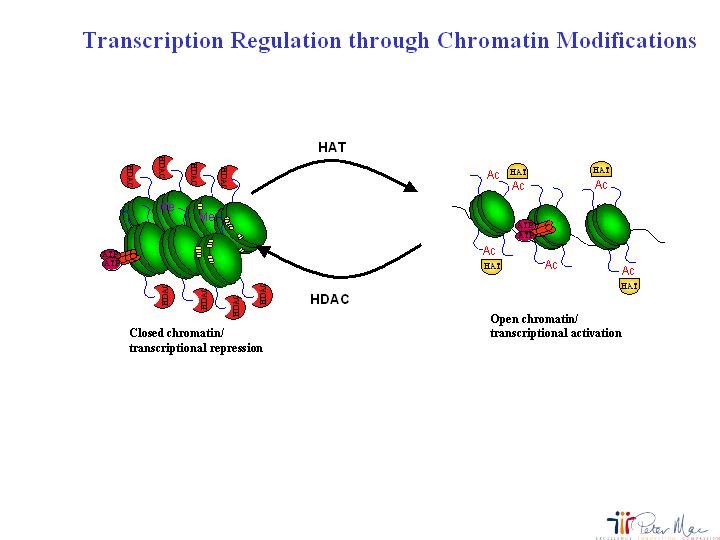
I thought to make the HDAC post a little clearer I would post a diagram of Histone/DNA interations and the results on DNA replication.
FDA Approves Merck & Co., Inc. (MRK)'s ZOLINZA(TM) For The Treatment Of Cutaneous Manifestations In Patients With Cutaneous T-Cell Lymphoma Who Have T
WHITEHOUSE STATION, N.J.--Merck & Co., Inc. announced today that the U.S. Food and Drug Administration (FDA) has approved oral ZOLINZA(TM) (vorinostat) 400 mg once daily for the treatment of cutaneous manifestations [skin lesions] in patients with cutaneous T-cell lymphoma (CTCL), a form of non-Hodgkin's lymphoma, who have progressive, persistent or recurrent disease on or following two systemic therapies. CTCL is a cancer of the T-cells, a type of white blood cell, which affects the skin.
"With today's FDA approval of ZOLINZA, there is now an effective new option in the fight against cutaneous manifestations of cutaneous T-cell lymphoma, specifically in patients who have tried and failed other cancer treatment options," said Elise Olsen, M.D., director, CTCL Clinic & Research Center at Duke University Medical Center and lead investigator of one of the studies that led to the approval.
ZOLINZA is a histone deacetylase (HDAC) inhibitor. WELL SO WHAT! WHAT THE HELL IS THAT?
DNA that is actively replicating is very stringy and not bunched up on itself such that polymerases etc can bind to it and do their job. When this occurs, the DNA has been acteylated, an acetyl group attached, so that it stays unwound and continues replicating. When there are no acetyl group attached, proteins called histones bind to the DNA and terminate transcription (replication). Zolinza helps stop the DNA from replicating (what cancer cells do and making more cancer cells) by stopping the removal of acyl groups.
Based on in vitro studies, ZOLINZA inhibits the enzymatic activity of HDAC1, HDAC2, HDAC3 and HDAC 6 at nanomolar [10 -9] concentrations (IC50<86 nM). In some cancer cells, excess amounts of the enzyme HDAC prevent the activation of genes that control normal cell activity. ZOLINZA is believed to decrease the activity of HDAC. Decreasing the activity of HDAC allows for the activation of genes that may help to slow or stop the growth of cancer cells. The exact mechanism of the anticancer effect of ZOLINZA has not been fully characterized.
MERCK (NYSE:MRK)was unchanged today at 41.86 but topped 42 dollars in early afternoon trading.
"With today's FDA approval of ZOLINZA, there is now an effective new option in the fight against cutaneous manifestations of cutaneous T-cell lymphoma, specifically in patients who have tried and failed other cancer treatment options," said Elise Olsen, M.D., director, CTCL Clinic & Research Center at Duke University Medical Center and lead investigator of one of the studies that led to the approval.
ZOLINZA is a histone deacetylase (HDAC) inhibitor. WELL SO WHAT! WHAT THE HELL IS THAT?
DNA that is actively replicating is very stringy and not bunched up on itself such that polymerases etc can bind to it and do their job. When this occurs, the DNA has been acteylated, an acetyl group attached, so that it stays unwound and continues replicating. When there are no acetyl group attached, proteins called histones bind to the DNA and terminate transcription (replication). Zolinza helps stop the DNA from replicating (what cancer cells do and making more cancer cells) by stopping the removal of acyl groups.
Based on in vitro studies, ZOLINZA inhibits the enzymatic activity of HDAC1, HDAC2, HDAC3 and HDAC 6 at nanomolar [10 -9] concentrations (IC50<86 nM). In some cancer cells, excess amounts of the enzyme HDAC prevent the activation of genes that control normal cell activity. ZOLINZA is believed to decrease the activity of HDAC. Decreasing the activity of HDAC allows for the activation of genes that may help to slow or stop the growth of cancer cells. The exact mechanism of the anticancer effect of ZOLINZA has not been fully characterized.
MERCK (NYSE:MRK)was unchanged today at 41.86 but topped 42 dollars in early afternoon trading.
Biotech Looks Set to Boil: Interesting article FYI
By Mark Manning
I like to look behind the sectors and indices in the limelight for stocks and sectors that are quietly gaining strength and building solid bases.
These are the areas that institutions will look to rotate money into when other sectors become too hot.
They are often washed-out sectors that have been out of favor for some time and are off momentum-investors' screens.
The biotech sector is gaining strength and breaking out of a low-level base that it fell into after breaking down following a strong run last November.
Last week, the Biotech HOLDRs broke up above the 200-day moving average on solid volume for the first time since March.
It pulled back a few days later, but it's now continuing its upward move.
I don't see a lot of resistance until it gets up around the $200 area. (See chart below.)
Amgen is the bellwether of the group, and it is leading the charge higher.
It has been building a base over the last five months.
Now that it has consolidated -- the latest move pushing above the 200-day moving average -- it looks like it wants to continue higher.
It doesn't have any major resistance until the $80-$85 area.
Any pullback on low volume could be an opportunity to take a position.
I'm setting up to take positions based on earnings and upcoming pipeline announcements before year's end. I think that the biotech sector as a whole will begin to rebound before the end of the year. I am keeping eyes open on PPHM (already in but may get even more) and THLD.
I like to look behind the sectors and indices in the limelight for stocks and sectors that are quietly gaining strength and building solid bases.
These are the areas that institutions will look to rotate money into when other sectors become too hot.
They are often washed-out sectors that have been out of favor for some time and are off momentum-investors' screens.
The biotech sector is gaining strength and breaking out of a low-level base that it fell into after breaking down following a strong run last November.
Last week, the Biotech HOLDRs broke up above the 200-day moving average on solid volume for the first time since March.
It pulled back a few days later, but it's now continuing its upward move.
I don't see a lot of resistance until it gets up around the $200 area. (See chart below.)
Amgen is the bellwether of the group, and it is leading the charge higher.
It has been building a base over the last five months.
Now that it has consolidated -- the latest move pushing above the 200-day moving average -- it looks like it wants to continue higher.
It doesn't have any major resistance until the $80-$85 area.
Any pullback on low volume could be an opportunity to take a position.
I'm setting up to take positions based on earnings and upcoming pipeline announcements before year's end. I think that the biotech sector as a whole will begin to rebound before the end of the year. I am keeping eyes open on PPHM (already in but may get even more) and THLD.
FDA Approves Sepracor, Inc. BROVANA Inhalation Solution For Chronic Obstructive Pulmonary Disease
MARLBOROUGH, Mass.--Sepracor Inc. today announced that the U.S. Food and Drug Administration (FDA) approved its New Drug Application (NDA) for BROVANA(TM) (arformoterol tartrate) Inhalation Solution 15 mcg (micrograms) as a long-term, twice-daily (morning and evening), maintenance treatment of bronchoconstriction in patients with chronic obstructive pulmonary disease (COPD), including chronic bronchitis and emphysema. BROVANA is for use by nebulization [see below] only.
BROVANA is the first long-acting beta2-agonist [Beta adrenoceptor type 2] to be approved as an inhalation solution for use with a nebulizer, which is a machine that converts liquid medication into a fine mist that is inhaled through a mouthpiece or mask.
"COPD mortality rates have been increasing and are expected to continue to rise," said William Bailey, M.D., Professor of Medicine, University of Alabama and Chairman, U.S. COPD Coalition, an organization comprised of 42 government, professional and patient groups dedicated to improving the lives of patients with COPD. "There are millions of Americans living with COPD(a) who may benefit from this new treatment option."
WHAT ARE beta2 receptors? These types of drugs, Beta2 agonists, work by bronchodilation. The open up the tubes in the lungs for easier breathing. They have a long duration of activity up to 3-4 hours. The most known, although not used very much anymore, is ephedrine, which was once used as an asthma treatment. Beta receptors regulate many functions in the body and are very large drug targets.
Sepracor is publicly traded on (Nasdaq: SEPR) is up 76 cents this morning to 50.96 in active trading.
BROVANA is the first long-acting beta2-agonist [Beta adrenoceptor type 2] to be approved as an inhalation solution for use with a nebulizer, which is a machine that converts liquid medication into a fine mist that is inhaled through a mouthpiece or mask.
"COPD mortality rates have been increasing and are expected to continue to rise," said William Bailey, M.D., Professor of Medicine, University of Alabama and Chairman, U.S. COPD Coalition, an organization comprised of 42 government, professional and patient groups dedicated to improving the lives of patients with COPD. "There are millions of Americans living with COPD(a) who may benefit from this new treatment option."
WHAT ARE beta2 receptors? These types of drugs, Beta2 agonists, work by bronchodilation. The open up the tubes in the lungs for easier breathing. They have a long duration of activity up to 3-4 hours. The most known, although not used very much anymore, is ephedrine, which was once used as an asthma treatment. Beta receptors regulate many functions in the body and are very large drug targets.
Sepracor is publicly traded on (Nasdaq: SEPR) is up 76 cents this morning to 50.96 in active trading.
I decided NOT to pull the trigger on Acordia:
They apparently have a few other trials to be announced from what I read, that may have a larger impact. Holding out until later in the year.
Markets are holding their ground after N. Korea tests. Alcoa kicks off earnings season, forcasts look strong. More science/trial data today.
Markets are holding their ground after N. Korea tests. Alcoa kicks off earnings season, forcasts look strong. More science/trial data today.
Sunday, October 08, 2006
Keeping an eye on this one:
LONDON -- Shares in Shire Pharmaceuticals rose 1.3% in London on Friday ahead a decision by the U.S. Food & Drug Administration on whether to approve Shire and New River Pharmaceuticals follow on product to Adderall XR. "Given the significance to Shire of Adderall XR - which accounted for around 55% of its 2005 sales -this news is likely to be highly significant," said analysts at Charles Stanley Securities. They said that they continue to believe the product, NRP-104, will get approval to launch early next year.
I will post tonight what Adderall XR is and how it works before the night is over.
I will post tonight what Adderall XR is and how it works before the night is over.
Getting ready for a Bull week--
Here are a few bigs with due earnings reports coming out this week:
Tuesday: Alcoa forcasted .78
Tuesday: Genentech forcased .50
Thursday: Pepsi Co forcast .86
Friday: GE .49 cents
Run with the bulls. Still have not reached a decision about Acordia.
Tuesday: Alcoa forcasted .78
Tuesday: Genentech forcased .50
Thursday: Pepsi Co forcast .86
Friday: GE .49 cents
Run with the bulls. Still have not reached a decision about Acordia.
Saturday, October 07, 2006
Apoptosis

A lot of the clinical trial data I have been reading investigate drugs to target proteins in the apoptosis pathway. I thought I would post a basic chart of some of the key components of the pathway that are drug targets.
A very limited list of publicly traded companies that have current apoptotic pipeline drugs are Eli Lilly, 3M, GlaxoSmith Kline, Merck, Novartis and on and on.
Eli Lilly initiates Phase I trials, Stock price closes down
Phase II trials for an experimental drug LY573636 are about to commence. The primary objective is to estimate the time to progressive disease for patients who receive LY573636 after two previous treatments for metastatic non-small cell lung cancer. Patients will receive an intravenous infusion of study drug once every 21 days. CT-scans will be done before the first dose and then after every other treatment.
HOW DOES THIS COMPOUND WORK?
LY573636 is a cytotoxic agent that appears to possess a unique mechanism of
action by inducing apoptosis [programmed cell death] in a variety of human tumor cell lines. It also appears to inhibit the proliferation of VEGF-stimulated endothelial cells [vascular endothelial growth factor-tells cells to grow] and it promotes tumor cell cycle arrest [tells tumor cells to stop dividing].
Demonstrates in vivo efficacy in colorectal xenograft [transplant] models.
Eli Lilly Trades on the NYSE under the symbol LLY. It closed friday down 20 cents to 57.56 in below average trading. Most of the major pharma companies were down however. I will follow the stage of this encouraging drug and post when I know more.
HOW DOES THIS COMPOUND WORK?
LY573636 is a cytotoxic agent that appears to possess a unique mechanism of
action by inducing apoptosis [programmed cell death] in a variety of human tumor cell lines. It also appears to inhibit the proliferation of VEGF-stimulated endothelial cells [vascular endothelial growth factor-tells cells to grow] and it promotes tumor cell cycle arrest [tells tumor cells to stop dividing].
Demonstrates in vivo efficacy in colorectal xenograft [transplant] models.
Eli Lilly Trades on the NYSE under the symbol LLY. It closed friday down 20 cents to 57.56 in below average trading. Most of the major pharma companies were down however. I will follow the stage of this encouraging drug and post when I know more.
Friday, October 06, 2006
Acordia volume, Price spike big moves
Acorda Therapeutics Inc.'s volume rose after the biotech drug developer announced a private placement of around 3.2 million newly issued shares of common stock at $9.75 per share, expected to close on Friday. Volume increased to 13 million shares, versus average volume of 1.6 million shares, with the stock climbing $1.32, or 10 percent, to $14.89.
Biotechnology company Panacos Pharmaceuticals Inc.'s volume tripled to 1.5 million. Earlier in the day, the company received an upgrade by Caris & Company to "Buy" from "Above Average." Shares climbed 53 cents, or 9 percent, to $6.16.
I'm all over this one. I will let you know if I decide to pull the trigger on this.
Biotechnology company Panacos Pharmaceuticals Inc.'s volume tripled to 1.5 million. Earlier in the day, the company received an upgrade by Caris & Company to "Buy" from "Above Average." Shares climbed 53 cents, or 9 percent, to $6.16.
I'm all over this one. I will let you know if I decide to pull the trigger on this.
Market Closed for the weekend:
Down 16.48. The bulls will be running again on Monday. Lots of data for you to read, when I get a chance. I'm following and reading up on Acordia therapeutics. Will post what I learn. Probably will make a move early monday.
Decode shares plummet due to Phase III study stoppage
Shares in Icelandic biotech firm Decode Genetics Inc's fell around 10 percent on Friday, hit by a manufacturing problem with its most advanced drug candidate, which is designed to prevent heart attacks.
The company -- a specialist in using population studies [large numbers of people to study many thousands] to find the genetic basis of disease -- suspended late-stage clinical tests of the medicine, known as DG031 or veliflapon, due to a formulation problem.
Decode said the tablets appeared to dissolve more slowly over time, which could eventually mean they released too little of the drug, potentially limiting the medicine's effect and undermining the Phase III study's chances of success. "While I cannot at this point say how much time will be required (to fix the problem), it will be a matter of several months at least," CEO Kari Stefansson told analysts in a conference call.
Shares are still dropping just before market close, down more than 14%.
The company -- a specialist in using population studies [large numbers of people to study many thousands] to find the genetic basis of disease -- suspended late-stage clinical tests of the medicine, known as DG031 or veliflapon, due to a formulation problem.
Decode said the tablets appeared to dissolve more slowly over time, which could eventually mean they released too little of the drug, potentially limiting the medicine's effect and undermining the Phase III study's chances of success. "While I cannot at this point say how much time will be required (to fix the problem), it will be a matter of several months at least," CEO Kari Stefansson told analysts in a conference call.
Shares are still dropping just before market close, down more than 14%.
It couldn't last forever... Wallstreet down
Stocks fell today as a mixed jobs report slowed the three-session run of gains, with General Motors Corp. a notable decliner after a key ally of billionaire shareholder Kirk Kerkorian resigned from the automaker's board.
I have a lot of data to post, but I'm busy right now with my formal job. I will get the data and interpretation up later today. A lot of trials coming out with the beginning of Q4.
I have a lot of data to post, but I'm busy right now with my formal job. I will get the data and interpretation up later today. A lot of trials coming out with the beginning of Q4.
Thursday, October 05, 2006
Elan Extends Tysabri's Reach
Pharmaceutical investors often forget that places beyond the United States and European Union have their own regulatory bodies that approve drugs -- and that some of these markets can be quite lucrative. Canada, Japan, and Australia are home to some of the biggest economies in the world, and they all have their own independent drug-regulation entities.
Smartly realizing the opportunity for sales growth, biopharmaceutical company Elan (NYSE: ELN - News) and partner Biogen Idec (Nasdaq: BIIB - News) have been diligently attempting to gain approval for the companies' multiple sclerosis product Tysabri in some of those other parts of the world. Yesterday, they announced a bit of success -- Canada's drug-regulatory agency has approved Tysabri to treat relapsing-remitting MS, the most common subtype of the disease.
To put this in perspective, Canada has possibly the highest rate of MS in the whole world. An estimated 55,000 to 75,000 Canadians suffer from the disease -- that's nearly one-fifth the estimated number of patients in the United States.
Tysabri, natalizumab, is a monoclonal antibody. This compound is the first of several antibodies in the pipeline targeting different steps in the immune dysfunction that leads to the clinical condition we call MS.
The exact mechanism of action by which natalizumab exerts its effects in multiple sclerosis is not fully defined. MS is believed to develop when activated inflammatory cells, including T cells, cross the blood brain barrier. No one is sure how the inflammatory cells are activated, but the result is the presence of highly active inflammatory cells within the CNS causing destruction of the "insulating" myelin sheath around nerves. Once damaged, the nerves cease functioning normally and the neurologic effects become the symptoms of MS.
Before the inflammatory cells can cross into the CNS, they must bind to the lining of the blood vessels, the endothelium. Natalizumab is thought to work by preventing this binding and hence stopping the migration of the damaging cells.
ELN closed down today 21 cents. I am getting in on the nonetheless.
Smartly realizing the opportunity for sales growth, biopharmaceutical company Elan (NYSE: ELN - News) and partner Biogen Idec (Nasdaq: BIIB - News) have been diligently attempting to gain approval for the companies' multiple sclerosis product Tysabri in some of those other parts of the world. Yesterday, they announced a bit of success -- Canada's drug-regulatory agency has approved Tysabri to treat relapsing-remitting MS, the most common subtype of the disease.
To put this in perspective, Canada has possibly the highest rate of MS in the whole world. An estimated 55,000 to 75,000 Canadians suffer from the disease -- that's nearly one-fifth the estimated number of patients in the United States.
Tysabri, natalizumab, is a monoclonal antibody. This compound is the first of several antibodies in the pipeline targeting different steps in the immune dysfunction that leads to the clinical condition we call MS.
The exact mechanism of action by which natalizumab exerts its effects in multiple sclerosis is not fully defined. MS is believed to develop when activated inflammatory cells, including T cells, cross the blood brain barrier. No one is sure how the inflammatory cells are activated, but the result is the presence of highly active inflammatory cells within the CNS causing destruction of the "insulating" myelin sheath around nerves. Once damaged, the nerves cease functioning normally and the neurologic effects become the symptoms of MS.
Before the inflammatory cells can cross into the CNS, they must bind to the lining of the blood vessels, the endothelium. Natalizumab is thought to work by preventing this binding and hence stopping the migration of the damaging cells.
ELN closed down today 21 cents. I am getting in on the nonetheless.
Friday's Methodology: PBMC
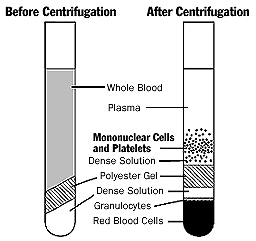
There have been a lot of data lately concerning HIV and HCV/HBV virus clinical trials. They often refer to PBMC isolation and in vitro/ in vivo [in the test tube/ in the body] study results. What the hell are PBMC anyway?
Well, PBMC is an acronym for peripheral blood mononuclear cells. These are the immune cells that are always in your blood. They get activated by such means as TLR ligands. One can easily isolate PBMC by using a centrifuge and a gradient such as a synthetic sugar such as Percoll or Ficoll, where you put the cells on top of the sugar and spin it until the cells reach a density in the sugar that matches their own.
Dynavax Technologies Positive Ragweed Data: Stock up 55%
Positive clinical trial data about a TLR-9 agonist [ what they are are in a earlier post, search TLR and you'll find it] and clearing allergic symptoms. I will make a more complete post later today explaining how this works. I work in this field, so this is HUGE!
Come back later to read!
Come back later to read!
Dynavax Stock Soars: Shares up 55% on Ragweed Trial Results
The New England Journal of Medicine Reports Positive Results From Dynavax Technologies Corporation (DVAX) Ragweed Allergy Therapy Trial; Dynavax Stock Soars
BERKELEY, Calif.,-- The NEW ENGLAND JOURNAL OF MEDICINE (Vol. 355, October 5, 2006, No.14), today reported that a new approach to allergy therapy not only reduced the acute allergic responses of individuals with ragweed allergies but also sustained that effect for over 12 months. The novel treatment, called "AIC" in the paper, is a TLR9 agonist linked to ragweed allergen, developed by Dynavax Technologies Corporation .
Dr. Peter Creticos, principal investigator and lead author of the paper, entitled, "Immunotherapy with a Ragweed-Toll-like Receptor 9 Agonist Vaccine for Allergic Rhinitis," said that the pilot study "appears to offer a means of achieving long-term clinical efficacy in ragweed allergic rhinitis as the clinical effects suggest the induction of long-lasting disease modification. Furthermore, the demonstrated therapeutic properties and safety pave the way for a therapeutic intervention that is qualitatively superior to standard immunotherapy." Dr. Creticos is Associate Professor of Medicine and Clinical Director of the Division of Clinical Immunology of The Johns Hopkins University School of Medicine. He serves as Medical Director of the Johns Hopkins Asthma and Allergy Center in Baltimore, Maryland.
In the paper, Dr. Creticos pointed to statistically significant efficacy results including peak Nasal Symptom Complex Score (NSCS) reductions in AIC-treated patients of 55% (p=0.03) in 2001 which persisted through the 2002 ragweed season (53% reduction in NSCS, p=0.02) with no additional therapy. Additionally, the AIC-treated group used no relief medication at all during the second season, while placebo patients used antihistamines for 8 days (average) and decongestants for 4 days (average) of the two-week peak season. The intervention also generated clinically significant quality of life improvements for patients. Dr. Creticos added that the intervention was safely tolerated as no treatment-associated serious adverse reactions were reported, nor did any lab tests show abnormalities in the patients tested.
So What does this mean? What are "TLRs" Anyway! --->About TLR-9 TLR is an acronym for Toll Like Receptor. Toll receptors were first characterized in the fly (Drosophilia) and more recently a related family of Toll like receptors in the vertebrate genome. They play a central role in innate immunity and are required for the adaptive immune response. [innate immunity is non-cell mediated, adaptive is mediated by cells of the immune system.] These receptors respond and recognize molecules from bacterial, viral and fungal pathogens. For example; if you eat bacterial contaminated food, the TLR receptors in your gut will recognize specific parts of the bacterial cell wall and essentially "yell for help". Other cells, such as natural killer and dendritic, then bolster the immune response by cytokine release. This is "bigtime news" and I hope the stock reflects this in the future. I will be in this as well.
BTW, there are numerous companies that use novel TLR agonists as drug therapies such as 3M, Coley and Anadys. Check them out.
BERKELEY, Calif.,-- The NEW ENGLAND JOURNAL OF MEDICINE (Vol. 355, October 5, 2006, No.14), today reported that a new approach to allergy therapy not only reduced the acute allergic responses of individuals with ragweed allergies but also sustained that effect for over 12 months. The novel treatment, called "AIC" in the paper, is a TLR9 agonist linked to ragweed allergen, developed by Dynavax Technologies Corporation .
Dr. Peter Creticos, principal investigator and lead author of the paper, entitled, "Immunotherapy with a Ragweed-Toll-like Receptor 9 Agonist Vaccine for Allergic Rhinitis," said that the pilot study "appears to offer a means of achieving long-term clinical efficacy in ragweed allergic rhinitis as the clinical effects suggest the induction of long-lasting disease modification. Furthermore, the demonstrated therapeutic properties and safety pave the way for a therapeutic intervention that is qualitatively superior to standard immunotherapy." Dr. Creticos is Associate Professor of Medicine and Clinical Director of the Division of Clinical Immunology of The Johns Hopkins University School of Medicine. He serves as Medical Director of the Johns Hopkins Asthma and Allergy Center in Baltimore, Maryland.
In the paper, Dr. Creticos pointed to statistically significant efficacy results including peak Nasal Symptom Complex Score (NSCS) reductions in AIC-treated patients of 55% (p=0.03) in 2001 which persisted through the 2002 ragweed season (53% reduction in NSCS, p=0.02) with no additional therapy. Additionally, the AIC-treated group used no relief medication at all during the second season, while placebo patients used antihistamines for 8 days (average) and decongestants for 4 days (average) of the two-week peak season. The intervention also generated clinically significant quality of life improvements for patients. Dr. Creticos added that the intervention was safely tolerated as no treatment-associated serious adverse reactions were reported, nor did any lab tests show abnormalities in the patients tested.
So What does this mean? What are "TLRs" Anyway! --->About TLR-9 TLR is an acronym for Toll Like Receptor. Toll receptors were first characterized in the fly (Drosophilia) and more recently a related family of Toll like receptors in the vertebrate genome. They play a central role in innate immunity and are required for the adaptive immune response. [innate immunity is non-cell mediated, adaptive is mediated by cells of the immune system.] These receptors respond and recognize molecules from bacterial, viral and fungal pathogens. For example; if you eat bacterial contaminated food, the TLR receptors in your gut will recognize specific parts of the bacterial cell wall and essentially "yell for help". Other cells, such as natural killer and dendritic, then bolster the immune response by cytokine release. This is "bigtime news" and I hope the stock reflects this in the future. I will be in this as well.
BTW, there are numerous companies that use novel TLR agonists as drug therapies such as 3M, Coley and Anadys. Check them out.
Another Day, Another Record! Bulls win again.
-- U.S. stock market futures held steady, with the Dow Jones Industrials Average at record high territory, as strength in retailers' September sales results helping offset a spike in crude-oil futures on OPEC's decision to cut output.
S&P 500 futures slipped 0.50 of a point at 1,357.80, while Nasdaq 100 futures rose 0.50 of a point at 1,693.00 Dow industrial futures eased 4 points to 11,902.
On Wednesday, the Dow industrials set a new record for the second day in a row, with the Dow jumping 123 points, the Nasdaq Composite rising 47 points and the S&P 500 rising 16 points.
OPEC on Thursday moved to cut production by a million barrels a day, according to published reports, sending crude futures back above the $60 a barrel market in electronic trade. Crude for November delivery rose $1.11 to $60.52 a barrel. See full story.
The U.S. Labor Dept. said initial claims for state unemployment insurance fell 17,000 to 302,000 during the week ending Sept. 30, the lowest mark since July 22.
Bonds fell after the report, with the yield on the 10-year Treasury note rising 0.023 percentage points at 4.588%.
A gauge of online U.S. employment recruitment slipped in September on reduced demand in the finance and real estate sectors. The Monster employment index fell to 172 in September from a record 173 in August, the online recruiting company said Thursday.
BIOTECH STOCKS WERE MIXED:
BOSTON-- Drug stocks closed mixed Wednesday while shares of Vertex Pharmaceuticals slid in the wake of a weakened first-quarter earnings report.
The Amex Pharmaceutical Index edged up 0.4% to close at 325.47 and the Amex Biotechnology Index fell 1.8% to 666.50.
Biotech index component Vertex skidded 7% to $34.82. After market close Tuesday, the anti-viral drug developer reported a quarterly net loss of $50.1 million, or 47 cents a share. This compared to a net loss of $44.7 million, or 56 cents a share, last year.
Biogen Idec dipped as low as $42.52 before closing down marginally at $44.07.
For the first quarter, Biogen posted earnings of $123 million, or 36 cents a share. The Cambridge, Mass.-based company netted $43 million, or 12 cents a share, in last year's corresponding period. Revenue climbed 4% to $611 million, from $588 million last year, but still fell short of Wall Street expectations. See full story.
S&P 500 futures slipped 0.50 of a point at 1,357.80, while Nasdaq 100 futures rose 0.50 of a point at 1,693.00 Dow industrial futures eased 4 points to 11,902.
On Wednesday, the Dow industrials set a new record for the second day in a row, with the Dow jumping 123 points, the Nasdaq Composite rising 47 points and the S&P 500 rising 16 points.
OPEC on Thursday moved to cut production by a million barrels a day, according to published reports, sending crude futures back above the $60 a barrel market in electronic trade. Crude for November delivery rose $1.11 to $60.52 a barrel. See full story.
The U.S. Labor Dept. said initial claims for state unemployment insurance fell 17,000 to 302,000 during the week ending Sept. 30, the lowest mark since July 22.
Bonds fell after the report, with the yield on the 10-year Treasury note rising 0.023 percentage points at 4.588%.
A gauge of online U.S. employment recruitment slipped in September on reduced demand in the finance and real estate sectors. The Monster employment index fell to 172 in September from a record 173 in August, the online recruiting company said Thursday.
BIOTECH STOCKS WERE MIXED:
BOSTON-- Drug stocks closed mixed Wednesday while shares of Vertex Pharmaceuticals slid in the wake of a weakened first-quarter earnings report.
The Amex Pharmaceutical Index edged up 0.4% to close at 325.47 and the Amex Biotechnology Index fell 1.8% to 666.50.
Biotech index component Vertex skidded 7% to $34.82. After market close Tuesday, the anti-viral drug developer reported a quarterly net loss of $50.1 million, or 47 cents a share. This compared to a net loss of $44.7 million, or 56 cents a share, last year.
Biogen Idec dipped as low as $42.52 before closing down marginally at $44.07.
For the first quarter, Biogen posted earnings of $123 million, or 36 cents a share. The Cambridge, Mass.-based company netted $43 million, or 12 cents a share, in last year's corresponding period. Revenue climbed 4% to $611 million, from $588 million last year, but still fell short of Wall Street expectations. See full story.
Wednesday, October 04, 2006
Today's Definition: Loss of Heterozygosity
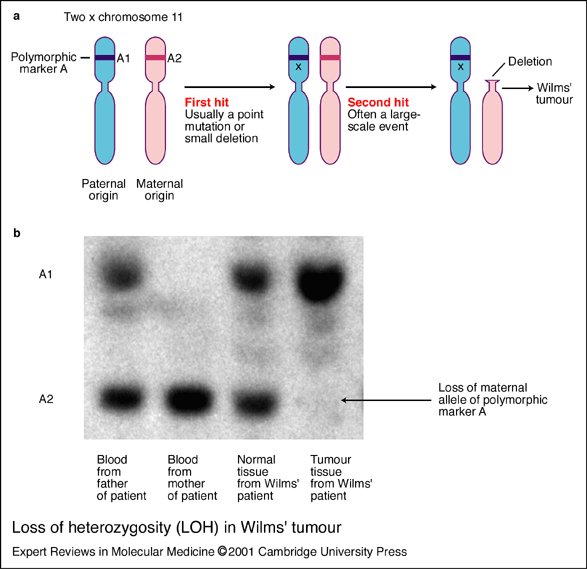
LOH: Describes a locus (or loci) on a gene at which a deletion or other process has converted (splice or insertion) the locus from heterozygosity to homozygosity or hemizygosity. The genes need to both be the same (eg, both must match from each chromosome). These phenomenon can lead to cancers by loss of tumor suppressor genes.
Big Action in Asia follows Dow Record Wednesday
HONG KONG-- Japan's Nikkei average led a region-wide advance Thursday as investors sought blue-chips such as Toyota Motor Corp. and Canon Inc. after the Dow industrials climbed to a second consecutive record-high close.
The Nikkei average of 225 companies was up as much as 1.6% in the afternoon session to 16,309.3. The Tokyo Stock Price Index, or Topix, rose 1.1% to 1,618.9.
Elsewhere around the region, Taiwan's leading share index climbed 1.4% to 6,970.6. Australia's S&P/ASX 200 was up 1.2%. Singapore's Straits Times Index advanced 0.8%. Malaysia's leading share index was up 0.4%, while Indonesia's Jakarta Composite traded flat.
Markets in China and South Korea were closed.
Hong Kong's Hang Seng Index (HK:1804580: news, chart, profile) was up 1.2% to 17,845.2.
"You are now getting to the state where people are momentum playing," said Andrew Sullivan, head of sales trading at Daiwa Securities SMBC in Hong Kong. "The market is currently trading only 150 points short of the 18,000 level...if it tests up to that sort of level you are likely to see some big trading blocks come through looking for laggards and just buying the whole of the market up."
The Nikkei average of 225 companies was up as much as 1.6% in the afternoon session to 16,309.3. The Tokyo Stock Price Index, or Topix, rose 1.1% to 1,618.9.
Elsewhere around the region, Taiwan's leading share index climbed 1.4% to 6,970.6. Australia's S&P/ASX 200 was up 1.2%. Singapore's Straits Times Index advanced 0.8%. Malaysia's leading share index was up 0.4%, while Indonesia's Jakarta Composite traded flat.
Markets in China and South Korea were closed.
Hong Kong's Hang Seng Index (HK:1804580: news, chart, profile) was up 1.2% to 17,845.2.
"You are now getting to the state where people are momentum playing," said Andrew Sullivan, head of sales trading at Daiwa Securities SMBC in Hong Kong. "The market is currently trading only 150 points short of the 18,000 level...if it tests up to that sort of level you are likely to see some big trading blocks come through looking for laggards and just buying the whole of the market up."
The top 5 BioTech Top Performers for Wednesday: FYI
Intraday Price Performance % Change Market Cap
BIO-MATRIX SCIENTIFI [BMSN.OB] +13.53% $0
COMBINATORX [CRXX] +10.95% $0
REXAHN PHARMACEUTICL [RXHN.OB] +10.91% $0
IDM PHARMA INC [IDMI] +8.86% $0
HEMOBIOTECH INC [HMBT.OB] +8.33% $0
I will try to post later WHY they finished the way they did. No doubt, it's a bull market!!
BIO-MATRIX SCIENTIFI [BMSN.OB] +13.53% $0
COMBINATORX [CRXX] +10.95% $0
REXAHN PHARMACEUTICL [RXHN.OB] +10.91% $0
IDM PHARMA INC [IDMI] +8.86% $0
HEMOBIOTECH INC [HMBT.OB] +8.33% $0
I will try to post later WHY they finished the way they did. No doubt, it's a bull market!!
Drug stocks mixed, Vertex slides on widened loss
BOSTON -- Drug stocks closed mixed Wednesday while shares of Vertex Pharmaceuticals slid in the wake of a weakened first-quarter earnings report.
The Amex Pharmaceutical Index edged up 0.4% to close at 325.47 and the Amex Biotechnology Index fell 1.8% to 666.50.
Biotech index component Vertex skidded 7% to $34.82. After market close Tuesday, the anti-viral drug developer reported a quarterly net loss of $50.1 million, or 47 cents a share. This compared to a net loss of $44.7 million, or 56 cents a share, last year.
For the first quarter, Biogen posted earnings of $123 million, or 36 cents a share. The Cambridge, Mass.-based company netted $43 million, or 12 cents a share, in last year's corresponding period. Revenue climbed 4% to $611 million, from $588 million last year, but still fell short of Wall Street expectations. See full story.
Discovery Laboratories was on the rebound, after sinking over 50% on Tuesday on news that manufacturing problems were delaying approval of its pediatric respiratory treatment Surfaxin.
Shares of Discovery shot up 17% to close at $2.58.
Also climbing was German drugmaker Bayer AG. The FDA awarded its drug candidate Nexavar orphan drug status in the treatment of liver cancer, meaning that if it receives approval, it will enjoy seven years of market exclusivity for that condition. Nexavar is already approved in the U.S. for the treatment of kidney cancer.
Gilead Sciences tumbled 7% to close at $57.31. The HIV drug developer announced on Tuesday that it had closed on a $1.3 billion sale of convertible senior notes.
The Amex Pharmaceutical Index edged up 0.4% to close at 325.47 and the Amex Biotechnology Index fell 1.8% to 666.50.
Biotech index component Vertex skidded 7% to $34.82. After market close Tuesday, the anti-viral drug developer reported a quarterly net loss of $50.1 million, or 47 cents a share. This compared to a net loss of $44.7 million, or 56 cents a share, last year.
For the first quarter, Biogen posted earnings of $123 million, or 36 cents a share. The Cambridge, Mass.-based company netted $43 million, or 12 cents a share, in last year's corresponding period. Revenue climbed 4% to $611 million, from $588 million last year, but still fell short of Wall Street expectations. See full story.
Discovery Laboratories was on the rebound, after sinking over 50% on Tuesday on news that manufacturing problems were delaying approval of its pediatric respiratory treatment Surfaxin.
Shares of Discovery shot up 17% to close at $2.58.
Also climbing was German drugmaker Bayer AG. The FDA awarded its drug candidate Nexavar orphan drug status in the treatment of liver cancer, meaning that if it receives approval, it will enjoy seven years of market exclusivity for that condition. Nexavar is already approved in the U.S. for the treatment of kidney cancer.
Gilead Sciences tumbled 7% to close at $57.31. The HIV drug developer announced on Tuesday that it had closed on a $1.3 billion sale of convertible senior notes.
ImClone climbs on renewed takeover speculation
BOSTON-- ImClone Systems Inc. shares jumped over 8% Wednesday after the biotech company revealed in documents released as part of its on-going squabble with dissident investor Carl Icahn that it had received an attractive takeover bid from an undisclosed pharmaceutical company.
In a regulatory filing, ImClone said that it had been approached in July by a "major international pharmaceutical company" who was interested in acquiring the biotech group in a stock deal worth $35.50 a share.
After the board rejected the offer as being too low, the pharmaceutical company upped the bid in September to $36 a share. The filing adds that the offer was contingent on Icahn's support, which he refused.
The name of ImClone's potential bidder was not disclosed.
Facing increased competition for its only marketed product, the colon cancer drug Erbitux, ImClone had announced in January that it was open to being acquired, but later took itself off the market in August because the bids it had received were too low.
Shares of ImClone were up 8% at $29.42 in midday trading. Remeber that Erbitux is a monoclonal antibody designed to inhibit the growth promoting epidermal growth factor receptor.
In a regulatory filing, ImClone said that it had been approached in July by a "major international pharmaceutical company" who was interested in acquiring the biotech group in a stock deal worth $35.50 a share.
After the board rejected the offer as being too low, the pharmaceutical company upped the bid in September to $36 a share. The filing adds that the offer was contingent on Icahn's support, which he refused.
The name of ImClone's potential bidder was not disclosed.
Facing increased competition for its only marketed product, the colon cancer drug Erbitux, ImClone had announced in January that it was open to being acquired, but later took itself off the market in August because the bids it had received were too low.
Shares of ImClone were up 8% at $29.42 in midday trading. Remeber that Erbitux is a monoclonal antibody designed to inhibit the growth promoting epidermal growth factor receptor.
More Info on Human Genome Science's HGS004
Turns out this drgu is a fully human monoclonal antibody to a specific receptor on cells. The receptor is called CCR5, which is one of the receptors the virus uses to enter cells. The antibody blocks this receptor, and probably causes it to be interalized, which prevents further cells being infected with the drug.
With less than an hour remaining in trading today, HGSI (NASDAQ) is up 42 cents to $12.43 in very heavy trading. I look for this stock to keep going up.
With less than an hour remaining in trading today, HGSI (NASDAQ) is up 42 cents to $12.43 in very heavy trading. I look for this stock to keep going up.
Human Genome Sciences Shares Jump
NEW YORK — Shares of biopharmaceutical company Human Genome Sciences Inc. jumped Monday, following positive results from an early stage study of its HIV treatment candidate.
The stock gained 41 cents, or 3.6 percent, to $11.95 in afternoon trading on the Nasdaq. Shares have traded between $7.63 and $14.15 over the last 52 weeks.
Late Friday, the company said its HIV treatment candidate HGS004 was shown to be well-tolerated and exhibit antiviral activity in a Phase I clinical trial. The company, which will host its annual analyst day Wednesday in New York, said it will determine the next step of development for HGS004 in the coming months.
In a note to investors Monday, Bank of America analyst David Witzke wrote "Human Genome Sciences remains our top pick for 2006." He reaffirmed a "Buy" rating for the stock with a $20 price target.
Witzke cited the expected upcoming announcement of the Phase III clinical trial design for the company's hepatitis C treatment Albuferon. That announcement could come as early as Wednesday, he wrote.
The analyst also noted the company's development pipeline. Human Genome Sciences has a total of seven drug candidates in clinical trials and four additional drugs in clinical development through partnerships.
Piper Jaffray analyst Edward A. Tenthoff reaffirmed a "Outperform" rating with an $18 price target.
He said several key points are helping to maintain a positive outlook for the company, including the expected Albuferon late-stage study and the upcoming start of Phase III trials of the company's Lymphostat B to treat lupus.
I will do some looking around to find out exactly what HGS004 is and how it works.
The stock gained 41 cents, or 3.6 percent, to $11.95 in afternoon trading on the Nasdaq. Shares have traded between $7.63 and $14.15 over the last 52 weeks.
Late Friday, the company said its HIV treatment candidate HGS004 was shown to be well-tolerated and exhibit antiviral activity in a Phase I clinical trial. The company, which will host its annual analyst day Wednesday in New York, said it will determine the next step of development for HGS004 in the coming months.
In a note to investors Monday, Bank of America analyst David Witzke wrote "Human Genome Sciences remains our top pick for 2006." He reaffirmed a "Buy" rating for the stock with a $20 price target.
Witzke cited the expected upcoming announcement of the Phase III clinical trial design for the company's hepatitis C treatment Albuferon. That announcement could come as early as Wednesday, he wrote.
The analyst also noted the company's development pipeline. Human Genome Sciences has a total of seven drug candidates in clinical trials and four additional drugs in clinical development through partnerships.
Piper Jaffray analyst Edward A. Tenthoff reaffirmed a "Outperform" rating with an $18 price target.
He said several key points are helping to maintain a positive outlook for the company, including the expected Albuferon late-stage study and the upcoming start of Phase III trials of the company's Lymphostat B to treat lupus.
I will do some looking around to find out exactly what HGS004 is and how it works.
Dow climbs new highs
NEW YORK -- U.S. stocks rose Wednesday, with the Dow Jones Industrial Average at a new all-time high, after encouraging data showing the economy growing at a steady pace, with inflation in check, but General Motors Corp. turned lower on a news report it has failed to reach agreement on an alliance with car makers Renault and Nissan Motor Co.
The Dow industrials rose as much 59 points to strike a fresh all-time high of 11,786. It was last up 47 points at 11,764.
The Nasdaq Composite Index was up 22 points at 2,266, while the S&P 500 Index gained 6 points a 1,339.
Biotech sector is also up 0.60% as well. The market is JUMPING!
The Dow industrials rose as much 59 points to strike a fresh all-time high of 11,786. It was last up 47 points at 11,764.
The Nasdaq Composite Index was up 22 points at 2,266, while the S&P 500 Index gained 6 points a 1,339.
Biotech sector is also up 0.60% as well. The market is JUMPING!
SkyePharma: Lodotra Phase III trial showed positive results
LONDON-- U.K. pharmaceutical SkyePharma said Wednesday that a Phase III clinical trial for Lodotra modified release tablets designed to optimize the efficacy of orally administered low-dose prednisone in Rheumatoid Arthritis showed positive results. Lodotra provides all the benefits of standard immediate release prednisone but has the additional, clinically important advantage of significantly reducing morning symptoms combined with a convenient dosing regimen, the company said.
AND here what it is......
GeoClock tablets have an active drug loaded inside an outer tablet layer consisting of a mixture of hydrophobic [water hating] wax and brittle material in order to obtain a pH-independent lag time prior to core drug delivery at a predetermined release rate.
This dry coating approach is designed to allow the timed release of both slow release and immediate release active cores by releasing the inner table first after which time the surrounding outer shell gradually disintegrates.
Using this novel technology, the pharma firm has been developing the new RA drug on behalf of another pharma company, Nitec.
According to SkyePharma, the drug, called Lodotra, will deliver the undisclosed active pharmaceutical ingredient (API) at the most appropriate time of day to treat the disease.
AND here what it is......
GeoClock tablets have an active drug loaded inside an outer tablet layer consisting of a mixture of hydrophobic [water hating] wax and brittle material in order to obtain a pH-independent lag time prior to core drug delivery at a predetermined release rate.
This dry coating approach is designed to allow the timed release of both slow release and immediate release active cores by releasing the inner table first after which time the surrounding outer shell gradually disintegrates.
Using this novel technology, the pharma firm has been developing the new RA drug on behalf of another pharma company, Nitec.
According to SkyePharma, the drug, called Lodotra, will deliver the undisclosed active pharmaceutical ingredient (API) at the most appropriate time of day to treat the disease.
Tuesday, October 03, 2006
Nikkei rides Dow coattails; oil, metals hit Australia
Japanese stocks took inspiration Wednesday morning from all-time highs set by the Dow Jones Industrial Average overnight, with blue-chips including Nintendo Co. and Toyota Motor rising sharply, while a fall in commodity prices hurt miners and oil producers.
The Nikkei 225 Index (JP:1804610: news, chart, profile) rose as much as 0.7% to 16,349.3. The broader Topix index gained as much as 0.5% to 1,625.2.
Australia's S&P/ASX 200 slipped as much as 0.3% as plunging oil and metal prices took a toll on energy and mining stocks. Woodside Petroleum (WOPEY :28.20, -0.85, -2.9% ) (AU:WPL: news, chart, profile) was off by 2.1% and BHP Billiton 37.28, -1.09, -2.8% ) (AU:BHP: news, chart, profile) fell 3%.
South Korean shares lost ground after North Korea announced Tuesday that it plans to test a nuclear weapon. Seoul's Kospi index lost as much as 0.3% in morning trading.
In Japan, Nintendo Co. (NTDOY :26.50, +0.55, +2.1% ) (JP:7974: news, chart, profile) shares gained as much as 4% after the company raised its earnings outlook late Tuesday afternoon, citing brisk sales of handheld game devices and software. See story.
Shares of Toyota Motor Co. (TM :111.03, +0.53, +0.5% ) (JP:7203: news, chart, profile) were up as much as 2.2% after it said
Tuesday that its September U.S. vehicle sales rose 25% from a year ago.
Crude oil for November delivery was down as much as 21 cents to $58.47 a barrel. It fell $2.35 to $58.68 a barrel on the New York Mercantile Exchange Tuesday, after reaching a low of $58.60. Those are levels the contract hasn't seen since late July 2005.
Gold for December delivery was up as much as 50 cents to $582. It closed down $21.80 at $581.50 an ounce on the New York Mercantile Exchange, its weakest closing level since mid-June.
The Dow industrials ($INDU:11,727.34, +56.99, +0.5% ) ended up 56.99 points at 11,727.34, surpassing the previous record closing high of 11,722.98 on Jan. 14, 2000.
The Nikkei 225 Index (JP:1804610: news, chart, profile) rose as much as 0.7% to 16,349.3. The broader Topix index gained as much as 0.5% to 1,625.2.
Australia's S&P/ASX 200 slipped as much as 0.3% as plunging oil and metal prices took a toll on energy and mining stocks. Woodside Petroleum (WOPEY :28.20, -0.85, -2.9% ) (AU:WPL: news, chart, profile) was off by 2.1% and BHP Billiton 37.28, -1.09, -2.8% ) (AU:BHP: news, chart, profile) fell 3%.
South Korean shares lost ground after North Korea announced Tuesday that it plans to test a nuclear weapon. Seoul's Kospi index lost as much as 0.3% in morning trading.
In Japan, Nintendo Co. (NTDOY :26.50, +0.55, +2.1% ) (JP:7974: news, chart, profile) shares gained as much as 4% after the company raised its earnings outlook late Tuesday afternoon, citing brisk sales of handheld game devices and software. See story.
Shares of Toyota Motor Co. (TM :111.03, +0.53, +0.5% ) (JP:7203: news, chart, profile) were up as much as 2.2% after it said
Tuesday that its September U.S. vehicle sales rose 25% from a year ago.
Crude oil for November delivery was down as much as 21 cents to $58.47 a barrel. It fell $2.35 to $58.68 a barrel on the New York Mercantile Exchange Tuesday, after reaching a low of $58.60. Those are levels the contract hasn't seen since late July 2005.
Gold for December delivery was up as much as 50 cents to $582. It closed down $21.80 at $581.50 an ounce on the New York Mercantile Exchange, its weakest closing level since mid-June.
The Dow industrials ($INDU:11,727.34, +56.99, +0.5% ) ended up 56.99 points at 11,727.34, surpassing the previous record closing high of 11,722.98 on Jan. 14, 2000.
AEterna Zentaris (AEZS) Announces Positive Phase 2 Results For Ozarelix In Benign Prostatic Hyperplasia
QUEBEC CITY, Oct. 3 - AEterna Zentaris Inc. today disclosed highly statistically significant positive data from its Phase 2 trial with ozarelix for patients suffering from benign prostatic hyperplasia (BPH). The study achieved its primary efficacy end-point of improving clinical symptoms of BPH, at week 12, as measured by significant changes in the International Prostate Symptom Score (I-PSS), the standard method of assessing BPH symptoms. This multi-center double-blind, randomized, placebo-controlled, dose-ranging Phase 2 trial included a total of 144 patients who received either different intramuscular dosage regimens of the luteinizing hormone-releasing hormone (LHRH) antagonist, ozarelix, or a placebo, to assess its safety and efficacy. The trial was conducted in Europe in collaboration with AEterna Zentaris' partner, Spectrum Pharmaceuticals Inc.
Secondary efficacy parameters such as uroflow, residual urinary volume, quality of life, and circulating testosterone levels were also measured and showed very good results especially with the day 1 and 15 administration of the 15 mg dose.
The results of the trial demonstrated an excellent safety profile with ozarelix where patients had no serious side effects. In particular, the erectile function, as measured by the International Index of Erectile Function, was not affected at any dose regimen.
WHAT DOES THIS MEAN?
This is exciting to me. I once worked on a project using prostate cells in culture. As prostate cancer progresses, the tumor becomes androgen independent (it doesn't need testosterone or other hormones) in order to continue to grow. So this drug is essentially blocking the early phase of the cancer ( and hyperplastic [swollen] prostate that's not cancer) by not allowing hormones to bind to the cells [which they need when becoming cancerous]. The I-PSS asks questions on a 1-5 scale meant to answer the severity of prostate related issues (such as frequency, how much etc).
AEterna Zentaris Inc. (TSX: AEZ : NASDAQ: AEZS) trades on both the Toronto Stock Exchange and the NASDAQ Index. On the NASDAQ, AEZS finished up 4 cents to $5.16. More than likely, they knew that the data was good, and it's figured into the stock price, noting the unimpressive rise in stock price. SPPI, it's partner company was up 6.6% at close today.
Secondary efficacy parameters such as uroflow, residual urinary volume, quality of life, and circulating testosterone levels were also measured and showed very good results especially with the day 1 and 15 administration of the 15 mg dose.
The results of the trial demonstrated an excellent safety profile with ozarelix where patients had no serious side effects. In particular, the erectile function, as measured by the International Index of Erectile Function, was not affected at any dose regimen.
WHAT DOES THIS MEAN?
This is exciting to me. I once worked on a project using prostate cells in culture. As prostate cancer progresses, the tumor becomes androgen independent (it doesn't need testosterone or other hormones) in order to continue to grow. So this drug is essentially blocking the early phase of the cancer ( and hyperplastic [swollen] prostate that's not cancer) by not allowing hormones to bind to the cells [which they need when becoming cancerous]. The I-PSS asks questions on a 1-5 scale meant to answer the severity of prostate related issues (such as frequency, how much etc).
AEterna Zentaris Inc. (TSX: AEZ : NASDAQ: AEZS) trades on both the Toronto Stock Exchange and the NASDAQ Index. On the NASDAQ, AEZS finished up 4 cents to $5.16. More than likely, they knew that the data was good, and it's figured into the stock price, noting the unimpressive rise in stock price. SPPI, it's partner company was up 6.6% at close today.
Cytokinetics' Drug Fails Head Cancer Trial; Analysts Not Surprised
NEW YORK -- Cytokinetics Inc. said late Monday its head and neck cancer drug candidate failed a midstage trial.
The South San Francisco-based drug developer said the drug, called ispinesib, at best only stabilized the disease in some patients.
A pair of analysts said they were not surprised by the news.
In a Tuesday note, RBC Capital Markets analyst Jason Kantor said he already had low expectations for the trial given results of past testing for ispinesib for other types of cancer.
He reiterated a "Sector Perform" rating on the company, and said it still has a promising heart failure medication in its pipeline, but said study data on it is not expected until later in 2007.
Rodman & Renshaw analyst Michael G. King in a client note dated Monday said ispinesib is more of a commercial candidate for breast and ovarian cancers. He reiterated a "Market Outperform" rating and a $10 target price on Cytokinetics.
Shares of Cytokinetics closed at $6.35 Monday on the Nasdaq.
The South San Francisco-based drug developer said the drug, called ispinesib, at best only stabilized the disease in some patients.
A pair of analysts said they were not surprised by the news.
In a Tuesday note, RBC Capital Markets analyst Jason Kantor said he already had low expectations for the trial given results of past testing for ispinesib for other types of cancer.
He reiterated a "Sector Perform" rating on the company, and said it still has a promising heart failure medication in its pipeline, but said study data on it is not expected until later in 2007.
Rodman & Renshaw analyst Michael G. King in a client note dated Monday said ispinesib is more of a commercial candidate for breast and ovarian cancers. He reiterated a "Market Outperform" rating and a $10 target price on Cytokinetics.
Shares of Cytokinetics closed at $6.35 Monday on the Nasdaq.
Late Day Trading NASDAQ leaders:
Just an FYI:
% Change Market Cap
BIO-MATRIX SCIENTIFI [BMSN.OB] +9.36% $0
ACORDA THERAPEUTICS [ACOR] +8.51% $0
MEMORY PHARMACEUTICA [MEMY] +8.49% $51.5 M
COMPUGEN LTD [CGEN] +4.91% $93.7 M
VIACELL, INC. [VIAC] +4.83% $296.9 M
% Change Market Cap
BIO-MATRIX SCIENTIFI [BMSN.OB] +9.36% $0
ACORDA THERAPEUTICS [ACOR] +8.51% $0
MEMORY PHARMACEUTICA [MEMY] +8.49% $51.5 M
COMPUGEN LTD [CGEN] +4.91% $93.7 M
VIACELL, INC. [VIAC] +4.83% $296.9 M
How RNAi works:
When viruses infect our cells, or when transposons and transgenes are randomly integrated into host genomes [such a a virus replicating-eg, the mononucleosis causing EBV], double-stranded RNA (dsRNA) is frequently produced from the foreign genes. Most eukaryotes, including humans, possess an innate cellular immune radar like system that specifically responds to the presence of dsRNA and activates processes that act post-transcriptionally [after the DNA has replicated] to silence the expression of the interloping genes. This mechanism is now commonly referred to as RNA interference or RNAi. During RNAi, long transcripts of dsRNA are rapidly processed into small interfering RNAs (siRNAs), which represent RNA duplexes of specific length and structure that finally guide sequence-specific degradation of mRNAs homologous in sequence to the siRNAs. siRNAs may be the best tools for target validation in biomedical research today and cancer therapeutics, because of their exquisite specificity, efficiency and endurance [ long lasting effect] of gene-specific silencing.
This topic can get very complicated in a hurry. I can go into more depth if there is interest.
Biiotech/Pharma companies that make RNAi reagents for research use are Invitrogen (NASDAQ: IVGN) and Sigma-Aldrich (NASDAQ:SIAL) just to name a few.
This topic can get very complicated in a hurry. I can go into more depth if there is interest.
Biiotech/Pharma companies that make RNAi reagents for research use are Invitrogen (NASDAQ: IVGN) and Sigma-Aldrich (NASDAQ:SIAL) just to name a few.
Dow Passes Intraday High Set in 2000
AP - The Dow Jones industrial average surged past its all-time trading high of 11,750.28 Tuesday, taking yet another step in its recovery from seven years of market turmoil.
The biotech market is up 2.91 to 1065.85.
Updates throughout the day, and I have not forgotten RNAi!
BTW, my pick of a stock for today (Biogen Idec NASDAQ:BIIB) is up 69 cents today to 44.93. See the post from last night.
The biotech market is up 2.91 to 1065.85.
Updates throughout the day, and I have not forgotten RNAi!
BTW, my pick of a stock for today (Biogen Idec NASDAQ:BIIB) is up 69 cents today to 44.93. See the post from last night.
CytRx Scientific Advisory Board Member Dr. Craig C. Mello Awarded Nobel Prize in Medicine for RNAi Discovery
LOS ANGELES--=CytRx Corporation (Nasdaq:CYTR - News) today applauded the announcement that its Scientific Advisory Board member Craig C. Mello, Ph.D., together with Andrew Fire, Ph.D., was awarded the Nobel Prize in medicine for discovery of the use of double-stranded RNA for gene silencing, a technology that has come to be known as RNA interference (RNAi). Drs. Mello and Fire acted as key inventors on the first approved RNAi patent, which is licensed to CytRx on a non-exclusive basis.
I will explain RNAi in a bit. Cool technology and indispensable now for the study of gene function. Congratulations, Dr. Mello!
I will explain RNAi in a bit. Cool technology and indispensable now for the study of gene function. Congratulations, Dr. Mello!
Monday, October 02, 2006
Do you have Biotech questions?
I work in the business of science. If you have a question about a clinical trial data, drug data or how something works, I have the resources of a major university, pharmaceutical company and > 10 years of research experience to help. Just leave a comment and I will do my best to answer as quickly as possible.
FYI, my stock watch favorite today [tuesday] is: Biogen / Idec on a collaboration MS drug.
FYI, my stock watch favorite today [tuesday] is: Biogen / Idec on a collaboration MS drug.
Asian stocks down on oil drop:
HONG KONG-- Asian stocks were lower Tuesday morning as a sharp overnight falloff in crude-oil prices sent energy stocks, including Japan's Inpex Holdings and Australia's Woodside Petroleum, downward.
The Nikkei 225 Average (JP:1804610: news, chart, profile) finished the morning session down 0.4% at 16,187.6. On Monday, the index rose for the fourth consecutive session and closed at its highest level in nearly a month.
The broader Topix index was down 0.6% at 1,614.9.
Hong Kong's Hang Seng Index (HK:1804580: news, chart, profile) was down as much as 0.6% to 17,444.5 in early trading.
"At these levels is seems momentum is lacking, so Hong Kong and Japan markets are listless and waiting for more figures to come out from the U.S.," said Peter Lai, sales director at DBS Vickers in Hong Kong. "Most regional markets are taking a wait and see approach."
He added that the Hong Kong market is seeing some draining of funds ahead of the initial public offering by Industrial and Commercial Bank of China, expected to be the largest IPO in history.
Australia's S&P/ASX 200 lost as much as 0.5%. Woodside Petroleum was off by as much as 2.7%.
Markets in South Korea and mainland China were closed Tuesday for holidays.
The Nikkei 225 Average (JP:1804610: news, chart, profile) finished the morning session down 0.4% at 16,187.6. On Monday, the index rose for the fourth consecutive session and closed at its highest level in nearly a month.
The broader Topix index was down 0.6% at 1,614.9.
Hong Kong's Hang Seng Index (HK:1804580: news, chart, profile) was down as much as 0.6% to 17,444.5 in early trading.
"At these levels is seems momentum is lacking, so Hong Kong and Japan markets are listless and waiting for more figures to come out from the U.S.," said Peter Lai, sales director at DBS Vickers in Hong Kong. "Most regional markets are taking a wait and see approach."
He added that the Hong Kong market is seeing some draining of funds ahead of the initial public offering by Industrial and Commercial Bank of China, expected to be the largest IPO in history.
Australia's S&P/ASX 200 lost as much as 0.5%. Woodside Petroleum was off by as much as 2.7%.
Markets in South Korea and mainland China were closed Tuesday for holidays.
News from the NASDAQ: BIOTECH STOCKS
After an upbeat day, Biotech closed down 10.92 or 1% on Monday. Here are some of today's top performing stocks from the NASDAQ:
Myogen, Inc. $35.08 $51.45 46.66% 1,814,730
GILD
Gilead Sciences, Inc. $68.77 $64.94 5.57% 1,015,634QQQQ
OPMR
Optimal Group, Inc. $11.76 $7.59 35.46% 574,72
CRYP
Cryptologic, Inc. $22.04 $15.46 29.85% 497,979
PSUN
Pacific Sunwear of California, Inc. $15.08 $16.12 6.90% 484,581
AAPL
Apple Computer, Inc. $76.98 $75.01 2.56% 428,104
MSFT
Microsoft Corporation $27.35 $27.32 0.11% 342,325
SCHW
Charles Schwab Corporation (The) $17.91 $17.93 0.11% 302,820
ORCL
Oracle Corporation $17.74 $17.91 0.96% 294,633
As of 10/2/2006 9:30:00 AM
GenTek, Inc. $27.61 $2000 7,143.75% 3,200
MYOG
Myogen, Inc. $35.08 $51.45 46.66% 1,814,730
UHCP
United Heritage Corporation $2.70 $3 11.11% 6,000
HEPH
Hollis-Eden Pharmaceuticals, Inc. $5.29 $5.80 9.64% 3,200
IFLO
I-Flow Corporation $12.02 $12.95 7.74% 9,099
PSUN
Pacific Sunwear of California, Inc. $15.08 $16.12 6.90% 484,581
RICK
Rick's Cabaret International, Inc. $7.97 $8.44 5.90% 4,210
BMRN
BioMarin Pharmaceutical Inc. $14.23 $15.05 5.76% 48,726
UNFI
United Natural Foods, Inc. $30.99 $32.39 4.52% 7,961
MNTG
MTR Gaming Group, Inc. $9.39 $9.81 4.47% 8,824
al Group, Inc. $11.76 $7.59 35.46% 574,727
CRYP
Cryptologic, Inc. $22.04 $15.46 29.85% 497,979
LCAV
LCA-Vision Inc. $41.31 $33 20.12% 280,034
GIGM
GigaMedia Limited $11.20 $9.75 12.95% 226,371
TRAC
Track Data Corporation $4.11 $3.67 10.71% 5,000
SKIL
SkillSoft plc $6.38 $5.99 6.11% 3,210
GILD
Gilead Sciences, Inc. $68.77 $64.94 5.57% 1,015,634
IONA
IONA Technologies PLC $4.50 $4.29 4.67% 4,801
BMHC
Building Materials Holding Corporation $26.02 $25.11 3.50% 4,600
AAPL
Apple Computer, Inc. $76.98 $75.01 2.56% 428,104
Myogen, Inc. $35.08 $51.45 46.66% 1,814,730
GILD
Gilead Sciences, Inc. $68.77 $64.94 5.57% 1,015,634QQQQ
OPMR
Optimal Group, Inc. $11.76 $7.59 35.46% 574,72
CRYP
Cryptologic, Inc. $22.04 $15.46 29.85% 497,979
PSUN
Pacific Sunwear of California, Inc. $15.08 $16.12 6.90% 484,581
AAPL
Apple Computer, Inc. $76.98 $75.01 2.56% 428,104
MSFT
Microsoft Corporation $27.35 $27.32 0.11% 342,325
SCHW
Charles Schwab Corporation (The) $17.91 $17.93 0.11% 302,820
ORCL
Oracle Corporation $17.74 $17.91 0.96% 294,633
As of 10/2/2006 9:30:00 AM
GenTek, Inc. $27.61 $2000 7,143.75% 3,200
MYOG
Myogen, Inc. $35.08 $51.45 46.66% 1,814,730
UHCP
United Heritage Corporation $2.70 $3 11.11% 6,000
HEPH
Hollis-Eden Pharmaceuticals, Inc. $5.29 $5.80 9.64% 3,200
IFLO
I-Flow Corporation $12.02 $12.95 7.74% 9,099
PSUN
Pacific Sunwear of California, Inc. $15.08 $16.12 6.90% 484,581
RICK
Rick's Cabaret International, Inc. $7.97 $8.44 5.90% 4,210
BMRN
BioMarin Pharmaceutical Inc. $14.23 $15.05 5.76% 48,726
UNFI
United Natural Foods, Inc. $30.99 $32.39 4.52% 7,961
MNTG
MTR Gaming Group, Inc. $9.39 $9.81 4.47% 8,824
al Group, Inc. $11.76 $7.59 35.46% 574,727
CRYP
Cryptologic, Inc. $22.04 $15.46 29.85% 497,979
LCAV
LCA-Vision Inc. $41.31 $33 20.12% 280,034
GIGM
GigaMedia Limited $11.20 $9.75 12.95% 226,371
TRAC
Track Data Corporation $4.11 $3.67 10.71% 5,000
SKIL
SkillSoft plc $6.38 $5.99 6.11% 3,210
GILD
Gilead Sciences, Inc. $68.77 $64.94 5.57% 1,015,634
IONA
IONA Technologies PLC $4.50 $4.29 4.67% 4,801
BMHC
Building Materials Holding Corporation $26.02 $25.11 3.50% 4,600
AAPL
Apple Computer, Inc. $76.98 $75.01 2.56% 428,104
Rituxan Receives Expanded FDA Approval
Genentech and Biogen Idec's Rituxan Gets Approval for Addition Non-Hodgkins Lymphoma Treatment
NEW YORK-- Drug developers Genentech Inc. and Biogen Idec Inc. said the Food and Drug Administration approved two new uses for Rituxan, covering two varieties of non-Hodgkins lymphoma.
The drug was first approved in 1997 to treat another form of non-Hodgkins lymphoma. Cambridge, Mass.-based Biogen developed the drug, which is co-marketed in the United States with South San Francisco, Calif.-based Genentech.
The first new indication is for Rituxan as part of a combination with chemotherapy as a first-line treatment for previously untreated patients with the follicular form of the blood cancer. The second indication deals with the drug as a second-line treatment in patients with a stable disease or after achieving a complete response following initial treatment with chemotherapy.
In February, the drug was approved as a first line treatment, in combination with chemotherapy, for patients with diffuse large B-Cell lymphoma. It is also being studied for use as a multiple sclerosis treatment.
Shares of Genentech rose $1.81, or 2.2 percent, to $84.51 on the New York Stock Exchange in midday trading. The stock has traded between $75.58 and $100.20 over the last 52 weeks. Shares of Biogen rose 11 cents to $44.79 on the Nasdaq.
Remember that rituxan is a humanized monoclonal antibody to a specific B cell antigen. When it binds to B cells, it triggers the patients immune system to see those cells as foreign and initials a cascade termed ADCC or antibody dependent cellular cytotoxicity. Think of a donut with toothpicks sticking out of it, the toothpicks are the antibodies which recruit the killer cells.
NEW YORK-- Drug developers Genentech Inc. and Biogen Idec Inc. said the Food and Drug Administration approved two new uses for Rituxan, covering two varieties of non-Hodgkins lymphoma.
The drug was first approved in 1997 to treat another form of non-Hodgkins lymphoma. Cambridge, Mass.-based Biogen developed the drug, which is co-marketed in the United States with South San Francisco, Calif.-based Genentech.
The first new indication is for Rituxan as part of a combination with chemotherapy as a first-line treatment for previously untreated patients with the follicular form of the blood cancer. The second indication deals with the drug as a second-line treatment in patients with a stable disease or after achieving a complete response following initial treatment with chemotherapy.
In February, the drug was approved as a first line treatment, in combination with chemotherapy, for patients with diffuse large B-Cell lymphoma. It is also being studied for use as a multiple sclerosis treatment.
Shares of Genentech rose $1.81, or 2.2 percent, to $84.51 on the New York Stock Exchange in midday trading. The stock has traded between $75.58 and $100.20 over the last 52 weeks. Shares of Biogen rose 11 cents to $44.79 on the Nasdaq.
Remember that rituxan is a humanized monoclonal antibody to a specific B cell antigen. When it binds to B cells, it triggers the patients immune system to see those cells as foreign and initials a cascade termed ADCC or antibody dependent cellular cytotoxicity. Think of a donut with toothpicks sticking out of it, the toothpicks are the antibodies which recruit the killer cells.
Gilead to acquire Myogen for $2.5 billion
NEW YORK - Gilead Sciences Inc. (GILD.O: Quote, Profile, Research), one of the world's biggest biotechnology companies, said on Monday it agreed to acquire tiny Myogen Inc. (MYOG.O: Quote, Profile, Research) for $2.5 billion to gain control of its promising hypertension drugs.
The transaction, the latest in a flurry of acquisitions in the drug and biotechnology sector, will give Gilead access to Myogen's experimental drugs ambrisentan to treat pulmonary arterial hypertension, or PAH, and darusentan for treating high blood pressure.
PAH causes extreme shortness of breath as the heart struggles to pump against high blood pressure in the lungs.
Foster City, California-based Gilead agreed to acquire all of Myogen's common stock at $52.50 per share, or a 50 percent premium to Myogen's closing stock price on Friday of $35.08. Myogen's shares rose 48 percent to $52.06 in pre-market trading.
Myogen is expected to seek approval for ambrisentan by the end of the year. The company is in a race with Encysive Pharmaceuticals Inc. (ENCY.O: Quote, Profile, Research) to produce a drug for PAH that can compete with Tracleer, a rival made by Actelion (ATLN.S: Quote, Profile, Research).
Encysive received a blow in July when U.S. regulators again asked for more information about its experimental PAH drug Thelin, before agreeing to approve it.
Geoffrey Porges, an analyst at Sanford Bernstein, said he expects ambrisentan to generate more than $1 billion a year, if approved, but he questioned the price of the deal and Gilead's rationale for the acquisition.
WHAT IS PH?
A condition in which blood pressure in the arteries of the lungs (pulmonary arteries) is abnormally high.
Blood travels from the right side of the heart through the pulmonary arteries into the lungs. There, carbon dioxide is removed from the blood and oxygen is added to it. Normally, the right side of the heart is weaker than the left side, because relatively little muscle and effort are needed to push the blood through the pulmonary arteries. In contrast, the left side of the heart is stronger and more muscular because it has to push blood through the entire body. Likewise, blood pressure through the pulmonary arteries is lower than that of the general circulation.
If the pressure of the blood in the pulmonary arteries is abnormally high, the condition is called pulmonary hypertension. Over time, the increased pressure damages both the large and small pulmonary arteries. The walls of the smallest blood vessels thicken and are no longer able to transfer oxygen and carbon dioxide normally between the blood and the lungs. Thus, the levels of oxygen in the blood may fall. The low oxygen level can cause narrowing (constriction) of the pulmonary arteries. These changes contribute further to the increased pressure in the pulmonary circulation.
With pulmonary hypertension, the right side of the heart must work harder to push the blood through the pulmonary arteries into the lungs. Over time, the right ventricle becomes thickened and enlarged, leading to a condition called cor pulmonale. Heart failure develops.
The transaction, the latest in a flurry of acquisitions in the drug and biotechnology sector, will give Gilead access to Myogen's experimental drugs ambrisentan to treat pulmonary arterial hypertension, or PAH, and darusentan for treating high blood pressure.
PAH causes extreme shortness of breath as the heart struggles to pump against high blood pressure in the lungs.
Foster City, California-based Gilead agreed to acquire all of Myogen's common stock at $52.50 per share, or a 50 percent premium to Myogen's closing stock price on Friday of $35.08. Myogen's shares rose 48 percent to $52.06 in pre-market trading.
Myogen is expected to seek approval for ambrisentan by the end of the year. The company is in a race with Encysive Pharmaceuticals Inc. (ENCY.O: Quote, Profile, Research) to produce a drug for PAH that can compete with Tracleer, a rival made by Actelion (ATLN.S: Quote, Profile, Research).
Encysive received a blow in July when U.S. regulators again asked for more information about its experimental PAH drug Thelin, before agreeing to approve it.
Geoffrey Porges, an analyst at Sanford Bernstein, said he expects ambrisentan to generate more than $1 billion a year, if approved, but he questioned the price of the deal and Gilead's rationale for the acquisition.
WHAT IS PH?
A condition in which blood pressure in the arteries of the lungs (pulmonary arteries) is abnormally high.
Blood travels from the right side of the heart through the pulmonary arteries into the lungs. There, carbon dioxide is removed from the blood and oxygen is added to it. Normally, the right side of the heart is weaker than the left side, because relatively little muscle and effort are needed to push the blood through the pulmonary arteries. In contrast, the left side of the heart is stronger and more muscular because it has to push blood through the entire body. Likewise, blood pressure through the pulmonary arteries is lower than that of the general circulation.
If the pressure of the blood in the pulmonary arteries is abnormally high, the condition is called pulmonary hypertension. Over time, the increased pressure damages both the large and small pulmonary arteries. The walls of the smallest blood vessels thicken and are no longer able to transfer oxygen and carbon dioxide normally between the blood and the lungs. Thus, the levels of oxygen in the blood may fall. The low oxygen level can cause narrowing (constriction) of the pulmonary arteries. These changes contribute further to the increased pressure in the pulmonary circulation.
With pulmonary hypertension, the right side of the heart must work harder to push the blood through the pulmonary arteries into the lungs. Over time, the right ventricle becomes thickened and enlarged, leading to a condition called cor pulmonale. Heart failure develops.
Monday's Cool Technique: Patch Clamping
I did a rotation in graduate school trying to learn this technique to study ion channels. I never could get a inside out patch.......though a Faraday cage is good if you take off a sweater really quick in winter. LOL
Click on the image to get a better view. My project was to study the cough suppressant dextromethorphan on calcium channels.
Labopharm Receives Approvable Letter From FDA For Once-Daily Tramadol
Labopharm Inc. today announced that it has received an approvable letter from the U.S. Food and Drug Administration (FDA) for its once-daily formulation of tramadol.
In its letter, the FDA indicated that Labopharm's once-daily formulation of tramadol is approvable subject to the resolution of certain issues. The Company plans to discuss the letter with the FDA as soon as possible and believes that it can address the issues raised in the letter without the need for additional data. Potential outcomes with respect to resolution of the issues range from utilization of current data to the need to generate additional data.
"We plan to work closely with the FDA to resolve the outstanding issues and obtain final approval," said James R. Howard-Tripp, President and Chief Executive Officer, Labopharm Inc. "We will provide further information following discussions with the FDA and clarification of the path forward."
Labopharm's New Drug Application (NDA) [IND] for its once-daily formulation of tramadol was submitted to the FDA in November 2005. The NDA included data from the Company's global clinical development program including six Phase III clinical studies and 12 pharmacokinetic studies. Combined, more than 2400 patients have been exposed to the product in clinical studies.
What is tramadol?
ULTRAM is a centrally acting synthetic opioid analgesic. Although its mode of action is not completely understood, from animal tests, at least two complementary mechanisms appear applicable: binding of parent and M1 metabolite to µ-opioid receptors and weak inhibition of reuptake of norepinephrine and serotonin.
Opioid activity is due to both low affinity binding of the parent compound and higher affinity binding of the O-demethylated metabo-lite M1 to µ-opioid receptors. In animal models,M1 is up to 6 times more potent than tramadol in producing analgesia and 200 times more potent in µ-opioid binding. Tramadol-induced analgesia is only partially antagonized by the opiate antagonist naloxone in several animal tests. The relative contribution of both tramadol and M1 to human analgesia is dependent upon the plasma concentrations of each compound (see CLINICAL PHARMACOLOGY, Pharmacokinetics).
Tramadol has been shown to inhibit reuptake of norepinephrine and serotonin in vitro, as have some other opioid analgesics. These mechanisms may contribute independently to the overall analgesic profile of ULTRAM. Analgesia in humans begins approximately within one hour after administration and reaches a peak in approximately two to three hours.
so why the hell is the stock down? here's why-- "We're pretty confident. You're not done until you're done," James Howard-Tripp, Labopharm president and CEO, told Reuters.
"We have got it approved in other jurisdictions. We believe it's a good product. We believe in our data package, so we would be pretty optimistic."
Labopharm shares dropped almost 25 percent on Friday after the company said it had received an approvable letter from the U.S. Food and Drug Administration for its version of the tramadol pain killer, but that the FDA said there are some unresolved issues.
The shares were down C$1.69, or 20.8 percent, at C$6.42 on the Toronto Stock Exchange, after dropping as low as C$6.09 earlier in the day. On Nasdaq, the shares were off $1.56, or 21.3 percent, at $5.75 after earlier falling as low as $5.42.
Howard-Tripp said the company plans to discuss the letter with the FDA "fairly rapidly" and believes it can address the issues raised without the need for additional data.
Howard-Tripp refused to say what issues were flagged---yeah no sh*&!! Once daily opioid for severe pain? OK........
(TSX: DDS, NASDAQ: DDSS)
In its letter, the FDA indicated that Labopharm's once-daily formulation of tramadol is approvable subject to the resolution of certain issues. The Company plans to discuss the letter with the FDA as soon as possible and believes that it can address the issues raised in the letter without the need for additional data. Potential outcomes with respect to resolution of the issues range from utilization of current data to the need to generate additional data.
"We plan to work closely with the FDA to resolve the outstanding issues and obtain final approval," said James R. Howard-Tripp, President and Chief Executive Officer, Labopharm Inc. "We will provide further information following discussions with the FDA and clarification of the path forward."
Labopharm's New Drug Application (NDA) [IND] for its once-daily formulation of tramadol was submitted to the FDA in November 2005. The NDA included data from the Company's global clinical development program including six Phase III clinical studies and 12 pharmacokinetic studies. Combined, more than 2400 patients have been exposed to the product in clinical studies.
What is tramadol?
ULTRAM is a centrally acting synthetic opioid analgesic. Although its mode of action is not completely understood, from animal tests, at least two complementary mechanisms appear applicable: binding of parent and M1 metabolite to µ-opioid receptors and weak inhibition of reuptake of norepinephrine and serotonin.
Opioid activity is due to both low affinity binding of the parent compound and higher affinity binding of the O-demethylated metabo-lite M1 to µ-opioid receptors. In animal models,M1 is up to 6 times more potent than tramadol in producing analgesia and 200 times more potent in µ-opioid binding. Tramadol-induced analgesia is only partially antagonized by the opiate antagonist naloxone in several animal tests. The relative contribution of both tramadol and M1 to human analgesia is dependent upon the plasma concentrations of each compound (see CLINICAL PHARMACOLOGY, Pharmacokinetics).
Tramadol has been shown to inhibit reuptake of norepinephrine and serotonin in vitro, as have some other opioid analgesics. These mechanisms may contribute independently to the overall analgesic profile of ULTRAM. Analgesia in humans begins approximately within one hour after administration and reaches a peak in approximately two to three hours.
so why the hell is the stock down? here's why-- "We're pretty confident. You're not done until you're done," James Howard-Tripp, Labopharm president and CEO, told Reuters.
"We have got it approved in other jurisdictions. We believe it's a good product. We believe in our data package, so we would be pretty optimistic."
Labopharm shares dropped almost 25 percent on Friday after the company said it had received an approvable letter from the U.S. Food and Drug Administration for its version of the tramadol pain killer, but that the FDA said there are some unresolved issues.
The shares were down C$1.69, or 20.8 percent, at C$6.42 on the Toronto Stock Exchange, after dropping as low as C$6.09 earlier in the day. On Nasdaq, the shares were off $1.56, or 21.3 percent, at $5.75 after earlier falling as low as $5.42.
Howard-Tripp said the company plans to discuss the letter with the FDA "fairly rapidly" and believes it can address the issues raised without the need for additional data.
Howard-Tripp refused to say what issues were flagged---yeah no sh*&!! Once daily opioid for severe pain? OK........
(TSX: DDS, NASDAQ: DDSS)
Subscribe to:
Posts (Atom)
